
What Can (and Can’t) a Special Needs Trust Pay For in 2026?
A Practical Guide for Georgia Families and Trustees
A special needs trust can give a person with disabilities access to resources that improve independence, comfort, opportunities, and quality of life while preserving access to important public benefits.
But special needs trust administration is not simply a matter of keeping a list of “allowed” and “prohibited” purchases.
The better question is:
What happens to the beneficiary's SSI, Medicaid, and other benefits if the trust pays this expense?
Sometimes the answer is that the expense has no effect at all. Sometimes a distribution may reduce an SSI payment but still make financial sense. And sometimes the manner in which the trustee makes the payment matters just as much as what is being purchased.
For Georgia families and trustees, understanding those distinctions is essential.

Protecting benefits without limiting quality of life.
Start With the Benefit, Not the Purchase
One of the most common misconceptions about special needs trusts is that the trust may only purchase things Medicaid or SSI will not cover.
That is too simplistic.
SSI has specific rules governing what counts as income and what constitutes in-kind support and maintenance, commonly called ISM. Medicaid has separate eligibility rules. The trust agreement itself may contain additional restrictions. A trustee also has fiduciary obligations to use trust property in accordance with the trust's terms and for the beneficiary's benefit.
The result is that the same purchase can have very different consequences depending on how it is structured.
For an individual receiving SSI in 2026, the federal resource limit remains $2,000 for an individual and $3,000 for a couple. The maximum federal SSI payment is $994 per month for an individual. (Social Security Administration)
Those limits make careful administration important, but they do not mean the beneficiary should be denied reasonable opportunities simply to preserve every dollar of SSI.

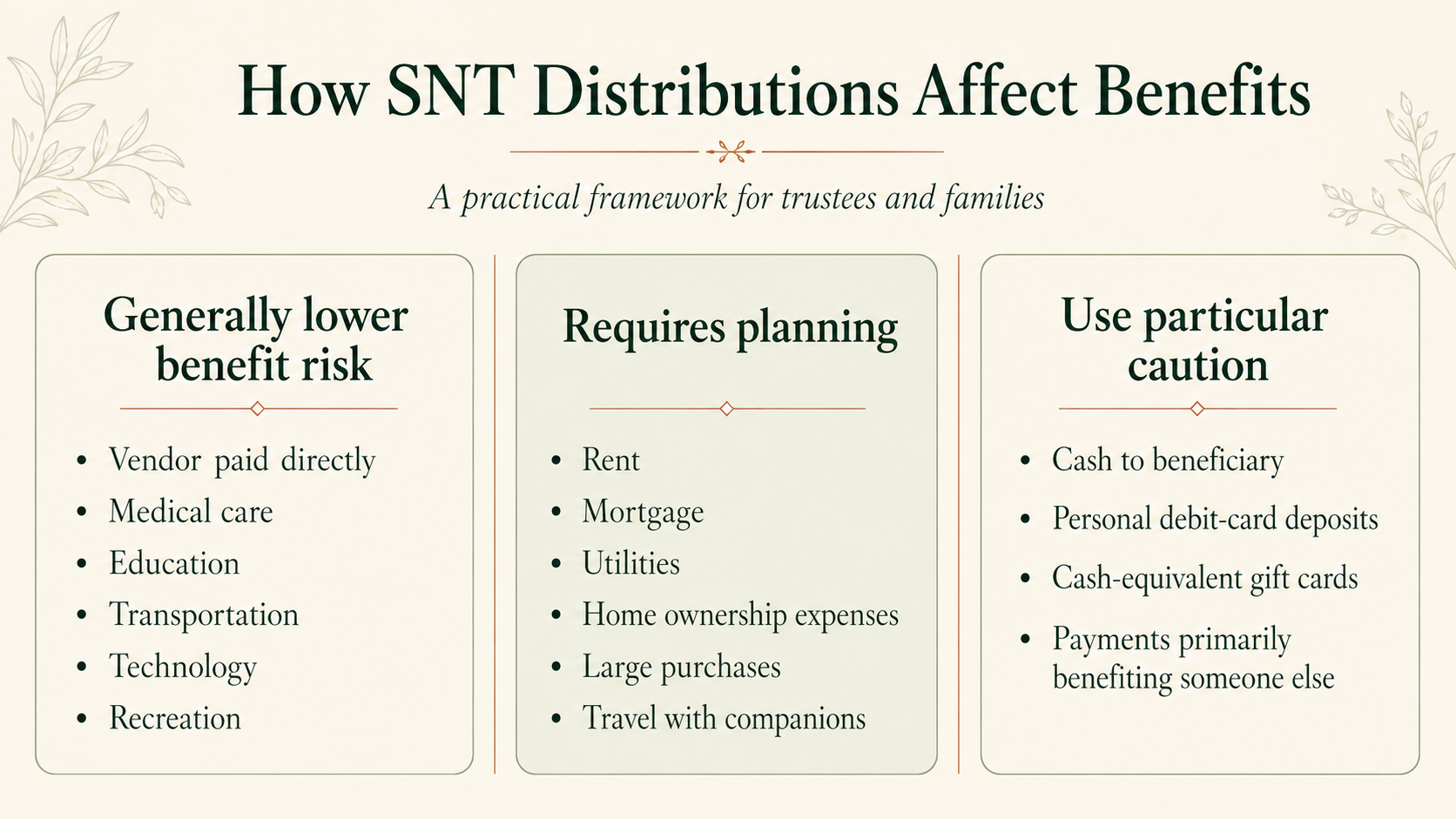
Cash: The Distribution Trustees Should Treat Most Carefully
Direct cash distributions are one of the clearest areas of concern.
When a trust that is not itself a countable resource gives cash directly to an SSI beneficiary, SSA generally treats the payment as unearned income. Loading money onto the beneficiary's personal debit card is treated similarly. (Social Security Administration)
That does not necessarily mean that every $20 distribution automatically reduces SSI by exactly $20. SSI has income exclusions, including a general $20 monthly exclusion in appropriate circumstances. But direct cash can quickly create avoidable benefit problems and should generally not be the default method for paying expenses. (Social Security Administration)
The cleaner approach is usually for the trustee to pay the provider or vendor directly.
A trustee can also reimburse a third party who has purchased an allowable item or service for the beneficiary, provided the transaction is properly documented. SSA specifically recognizes qualifying third-party reimbursements as different from cash delivered to the beneficiary. (Social Security Administration)
Gift Cards Are Not the Same as Buying the Item
This is a particularly important 2026 distinction.
Gift cards and gift certificates are not automatically safe simply because the ultimate purchase would be permissible.
SSA may treat a gift card as income when it can be used to purchase food or shelter or when it can be resold. An unrestricted Visa-type gift card is therefore very different from the trustee purchasing an item directly from a retailer. (Social Security Administration)
For example, a trustee purchasing a computer directly for the beneficiary may present no SSI problem. Giving the beneficiary an unrestricted $1,500 prepaid card to buy the computer creates an entirely different analysis.
The method of payment matters.

Can a Special Needs Trust Pay for Rent or a Mortgage?
Yes.
This is where the original “prohibited expenses” approach becomes especially misleading.
A special needs trust can pay rent, mortgage payments, real property taxes and certain utilities. The issue is that shelter provided by another person or entity may constitute ISM and reduce the beneficiary's SSI payment.
In 2026, the maximum reduction attributable to this type of support can be as much as $351.33 per month, depending on the beneficiary's circumstances. (Social Security Administration)
That creates a planning decision rather than an automatic prohibition.
Suppose an SSI beneficiary needs $1,400 per month toward an appropriate apartment. It may make very good sense for the trustee to pay the housing expense even if doing so reduces SSI by several hundred dollars.
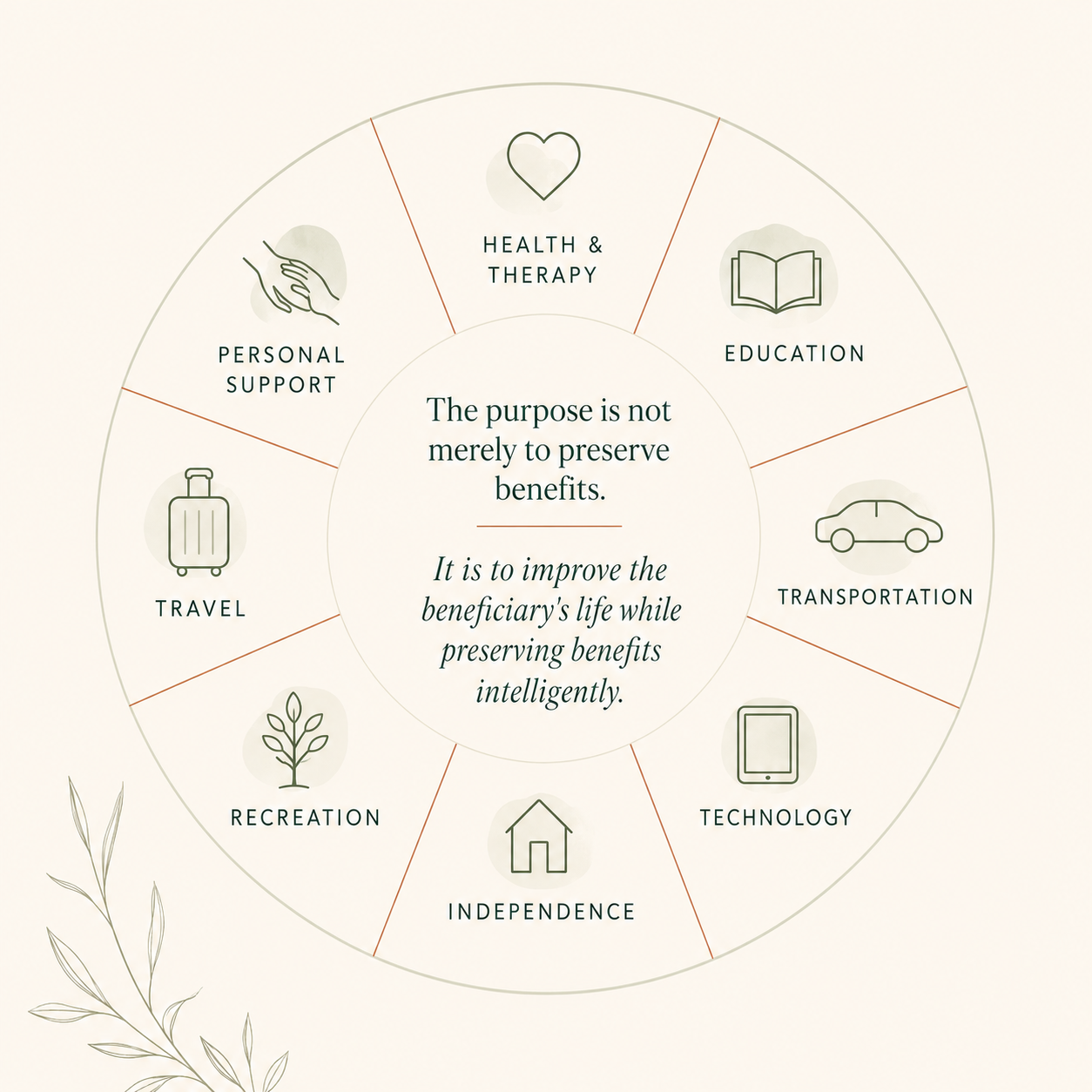
Preserving benefits should support the beneficiary's life. It should not become an end in itself.
What SSA Treats as Shelter
SSA's shelter categories include rent, mortgage payments, real property taxes, heating fuel, gas, electricity, water, sewer, garbage removal and certain property insurance required by a mortgage lender. Condominium or association fees are not automatically shelter costs, although identifiable shelter expenses contained within them can be counted. (Social Security Administration)
That distinction can matter considerably when a trust owns or helps maintain a residence for a beneficiary.

Housing is not automatically “off limits.”
The question is how the payment affects SSI and whether the benefit justifies the tradeoff.
The Food Rules Changed in 2024
For decades, food and shelter were both included in SSI's ISM rules.
That changed on September 30, 2024.
SSA no longer includes food when calculating ISM. The change means that food provided to an SSI recipient is no longer treated the same way as shelter assistance for purposes of calculating ISM. (Social Security Administration)
This gives trustees considerably more flexibility to pay directly for items such as groceries, meals and food delivery.
But there is a trap.
A trustee buying groceries directly is different from giving the beneficiary a grocery-store or Visa gift card. Under SSA's separate gift-card rules, a card usable for food or shelter may itself constitute unearned income. (Social Security Administration)
That makes this a useful rule of thumb:
Buy the food. Do not assume giving the beneficiary money to buy the food produces the same result.
What Can a Special Needs Trust Commonly Pay For?
Properly drafted and administered special needs trusts can provide much more than medical care.
SSA's own trust guidance identifies educational expenses, therapy, transportation, professional fees, uncovered medical services, telephone expenses, recreation and entertainment among the types of third-party expenditures that generally do not constitute income to the beneficiary. (Social Security Administration)
Depending on the trust instrument and beneficiary's circumstances, trust funds may also be used for assistive technology, computers and electronics, accessibility modifications, transportation, personal-care services, education and vocational training, travel and recreation, hobbies, memberships, household furnishings, legal and financial services, and other expenditures that enhance the beneficiary's independence and quality of life.
The trustee should still consider whether an item could become a countable resource once owned by the beneficiary. A vehicle is a good example: SSI generally excludes one vehicle used for transportation, but the facts matter when the beneficiary or household already owns other vehicles. (Social Security Administration)
First-Party and Third-Party Special Needs Trusts Are Not the Same
The source of the money matters.
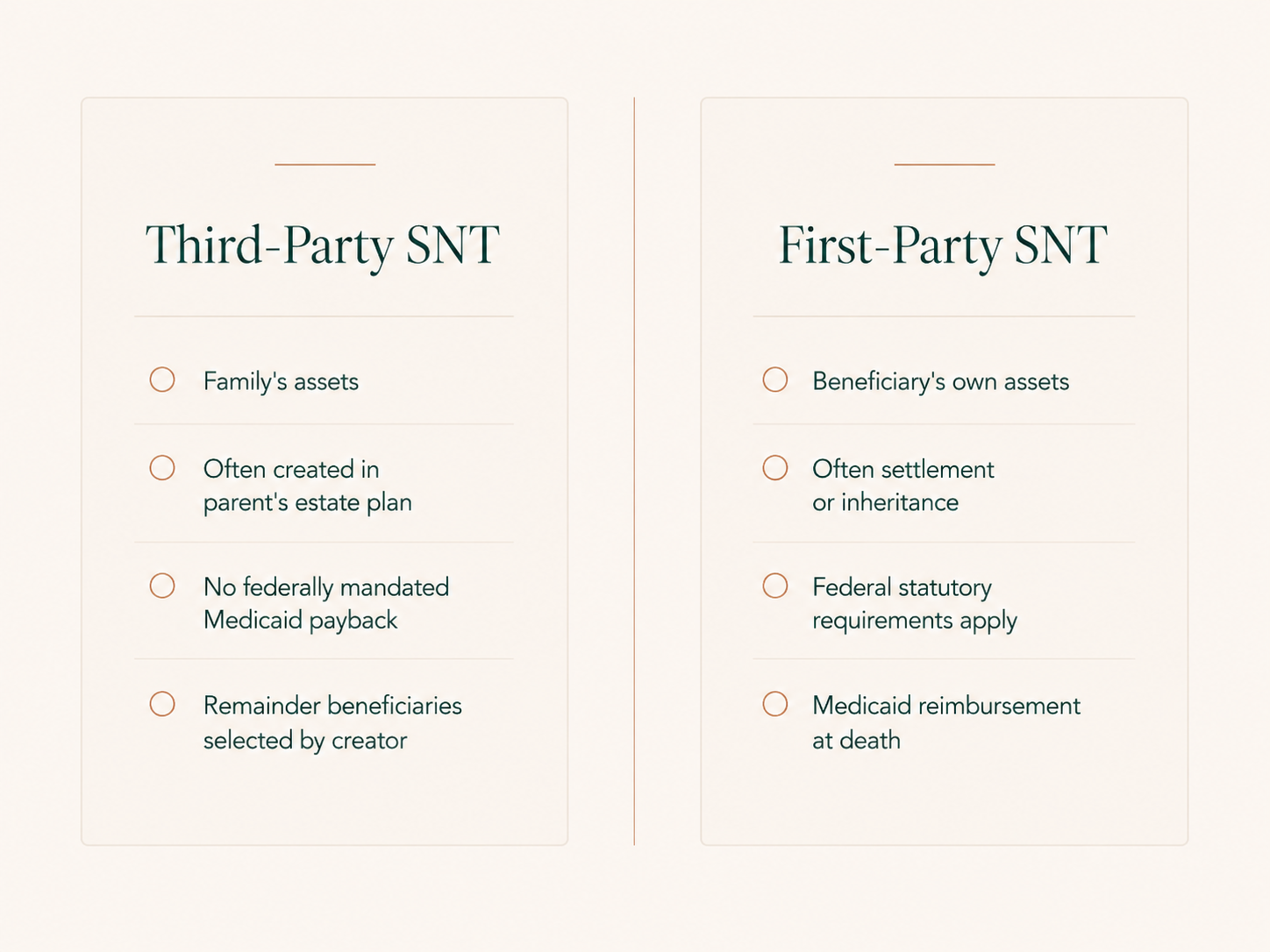
A third-party special needs trust is generally funded with assets belonging to someone other than the beneficiary, often a parent or grandparent. Properly structured, it can preserve assets for other remainder beneficiaries after the beneficiary's death without a federally required Medicaid reimbursement provision.
A first-party special needs trust is funded with the beneficiary's own property, such as an inheritance, settlement proceeds or assets already owned by the beneficiary. To qualify for the federal special-needs-trust exception, the trust must contain the required Medicaid reimbursement provision. Upon the beneficiary's death, the state or states that provided Medicaid benefits generally have priority to reimbursement from remaining trust assets. (Social Security Administration)
That distinction is critically important for estate planning, trust drafting and end-of-life administration.
It does not, however, mean that there is one simple spending list for first-party trusts and an entirely different list for third-party trusts.
The actual analysis requires looking at the trust document, the source of funds, SSI rules, Medicaid rules and the beneficiary's circumstances.
A 2026 Planning Opportunity: SNTs and ABLE Accounts
Another significant change arrived on January 1, 2026.
ABLE eligibility now extends to individuals whose disability began before age 46, rather than the previous age-26 threshold. SSA estimates that the expansion may make millions of additional individuals eligible to use an ABLE account. (Social Security Administration)
The regular annual ABLE contribution limit is $20,000 for 2026, with additional contribution opportunities for certain employed beneficiaries. (IRS)
ABLE accounts and special needs trusts serve different purposes, but they can work together. SSA expressly permits transfers from a qualifying trust to the beneficiary's ABLE account without treating the transfer as income to the beneficiary. (Social Security Administration)
For some families, that combination can provide significantly more flexibility for everyday spending.

How Trustees Can Reduce Mistakes
The most effective trust administration is usually not complicated. It is deliberate.
Before making a significant distribution, the trustee should identify the benefit programs the beneficiary receives, review the governing trust language, determine whether the purchase could constitute income or a countable resource, decide whether direct vendor payment is preferable, and maintain receipts and records showing what was purchased and why it benefited the beneficiary.
For recurring or large expenses, particularly housing, vehicles, travel with companions, home purchases, caregiver arrangements or distributions involving an ABLE account, reviewing the plan before money changes hands can prevent substantially more expensive problems later.
Documentation matters as well. A bank or credit-card statement may show where money was spent but not what was purchased. Itemized invoices and receipts provide a much better administrative record.
Frequently Asked Questions
Can an SNT pay for a car?
Often, yes. Transportation is commonly an appropriate trust expense, but vehicle ownership and the beneficiary's existing resources should be reviewed.
Can an SNT pay for a vacation?
Generally, yes, when permitted by the trust and undertaken for the beneficiary's benefit. Companion travel expenses may require additional analysis.
Can an SNT pay for rent?
Yes. Rent is not prohibited. It may create shelter ISM and reduce SSI, so the trustee should compare the value of the housing assistance with the potential benefit reduction.
Can an SNT pay for groceries or restaurant meals?
Food itself is no longer included in SSI's ISM calculation. Direct payment is generally preferable to handing the beneficiary cash or a gift card.
Can an SNT pay for a cell phone or computer?
Generally, yes. SSA expressly recognizes phone expenses among examples of third-party trust expenditures that ordinarily do not constitute income. (Social Security Administration)
Should a trustee ever intentionally make a distribution that reduces SSI?
Potentially, yes. A trustee's objective is not necessarily to maximize the SSI check at all costs. A housing payment or other expenditure may provide substantially greater value to the beneficiary than the amount of SSI lost.
That decision should be intentional and documented.

The Better Question Is Not “Can the Trust Pay for It?”
The better question is:
What is the most effective way for the trust to provide this benefit?
Special needs planning should preserve access to public benefits without unnecessarily restricting the beneficiary's life.
For some purchases, the answer is straightforward. For others, a small change in the payment method can produce a very different benefits result. Housing decisions, significant purchases, first-party trust distributions and coordination with ABLE accounts deserve particular attention.
Conner Law Group works with Georgia families to create, review and administer special needs trusts and to coordinate those trusts with SSI, Medicaid, ABLE accounts and the family's broader estate plan.
Before making a distribution you are uncertain about, it is often easier to review it first than to correct a benefits problem afterward.
Planning for someone with special needs?
The right trust is only part of the plan. How the trust is funded and administered matters too.
SEO and visual direction
SEO title:
What Can a Special Needs Trust Pay For? | Georgia 2026 Guide
Meta description:
Learn what a special needs trust can pay for, how rent, food, cash and gift cards affect SSI, and what Georgia trustees should know in 2026.
Suggested URL slug:
/special-needs-trust-what-can-it-pay-for
For the imagery, I would stay away from the typical blue “disability law” stock aesthetic. The strongest version for Conner Law Group would use white/cream backgrounds, dark forest green, muted sage, restrained copper, editorial photography, Playfair Display-style headlines, Inter-style body typography, and occasional botanical line art. Four images/graphics plus the hero is enough to break up the article without making it feel visually busy.
The revised version also gives you a much better conversion message: special needs planning is not about saying “no” to purchases; it is about structuring them intelligently. That feels more consistent with the firm's broader planning-oriented positioning.
