
How Much Does a Special Needs Trust Cost in Georgia? A 2026 Guide

For many Georgia families, the cost of creating a special needs trust is measured in several thousand dollars.
The exact amount, however, depends on much more than the document itself. The type of trust, the source of the money, the trustee, tax treatment, court involvement, and the broader estate plan can all affect the total cost.
Online estimates often place the legal fee for a special needs trust between $2,000 and $5,000. That may be a useful starting point, but it is not a reliable quote for every family. A third-party trust created as part of a parent’s estate plan is very different from a first-party trust receiving settlement proceeds. A pooled trust may have a lower initial cost but ongoing enrollment and administration fees.
The better question is not simply, “What is the least expensive trust?” It is, “Which structure protects the beneficiary, works with the family’s estate plan, and can be administered responsibly over time?”
This guide explains the costs Georgia families should consider before creating a special needs trust.
Why the Cost of a Special Needs Trust Matters
A special needs trust is designed to hold and manage assets for a person with a disability without automatically treating those assets as the beneficiary’s own resources for certain means-tested benefit programs. When properly drafted, funded, and administered, the trust can help preserve access to programs such as Supplemental Security Income (SSI) and Medicaid while providing additional support for the beneficiary’s quality of life.
That protection matters because SSI continues to apply a countable-resource limit of $2,000 for an individual and $3,000 for a couple. Those limits reached their current levels in 1989 and have not been indexed for inflation. The Social Security Administration explains the current limits and their history here.
A direct inheritance, settlement, or beneficiary-designation payment can therefore create serious benefit issues. The cost of correcting a poorly coordinated transfer may exceed the cost of planning correctly in the first place.
What Determines the Cost of a Special Needs Trust in Georgia?
There is no single statewide fee for a special needs trust. The following factors usually have the greatest effect on cost.
1. The type of special needs trust
A third-party special needs trust is funded with assets belonging to someone other than the beneficiary, such as a parent or grandparent. It is often created as part of the family’s broader estate plan.
A first-party special needs trust holds assets that already belong to the beneficiary, such as a personal injury settlement or an inheritance received outright. Federal law imposes specific requirements on this type of trust, including a Medicaid-reimbursement provision. Under 42 U.S.C. § 1396p(d)(4)(A), the beneficiary must be disabled and under age 65 when the trust is established and funded under that statutory exception.
Because a first-party trust must address additional benefit rules, reimbursement language, and sometimes settlement or court requirements, it often requires more legal work than a straightforward third-party plan.
2. Whether the trust is part of a complete estate plan
For a parent planning for a child with a disability, the trust should rarely be viewed in isolation. The family may also need:
Wills or a revocable living trust;
Financial powers of attorney;
Advance healthcare directives and HIPAA authorizations;
Coordinated beneficiary designations;
Trustee and successor-trustee planning;
Guardianship, conservatorship, or supported decision-making guidance; and
A practical plan for housing, care, advocacy, and future decision-making.
Bundling the special needs trust with the family’s estate plan may be more efficient than preparing disconnected documents at different times. More importantly, it reduces the risk that a will, retirement account, or life insurance policy will direct assets to the beneficiary individually and undermine the plan.
3. The source, amount, and type of assets
A trust intended to receive a modest life insurance benefit may be simpler than one that will hold real estate, retirement assets, business interests, or settlement proceeds. Retirement accounts require particular care because trust language and beneficiary designations can affect both income-tax treatment and distribution timing.
The amount involved also affects the practical choice of trustee. A professional trustee may provide valuable continuity and benefits-sensitive administration, but minimum annual fees can be disproportionate for a smaller trust.
4. Trustee selection
The trustee manages the assets, reviews distribution requests, keeps records, coordinates tax reporting, and applies the trust’s terms. Trustee compensation may be:
A percentage of assets under management;
A stated minimum annual fee;
An hourly fee;
A flat monthly or annual fee; or
Uncompensated service by a family member.
A family member may reduce direct fees, but that does not make administration cost-free. The trustee must understand benefit rules, maintain records, avoid prohibited self-dealing, communicate with the beneficiary and family, and know when to seek legal, tax, investment, or benefits advice.
Before selecting a trustee, ask for a written fee schedule and determine whether investment-management, tax-preparation, distribution, real-estate, termination, or extraordinary-service fees are charged separately.
5. Court or settlement involvement
Some first-party trusts are created in connection with a personal injury settlement, guardianship, conservatorship, or court order. Those matters may involve filing fees, hearings, settlement-planning professionals, structured-settlement advice, bond issues, or ongoing court reporting.
Court involvement is not required in every first-party trust matter. Whether it is necessary depends on the beneficiary’s capacity, the source of the funds, the litigation posture, and the authority of the person acting for the beneficiary.
Setup Costs and Ongoing Costs Are Different
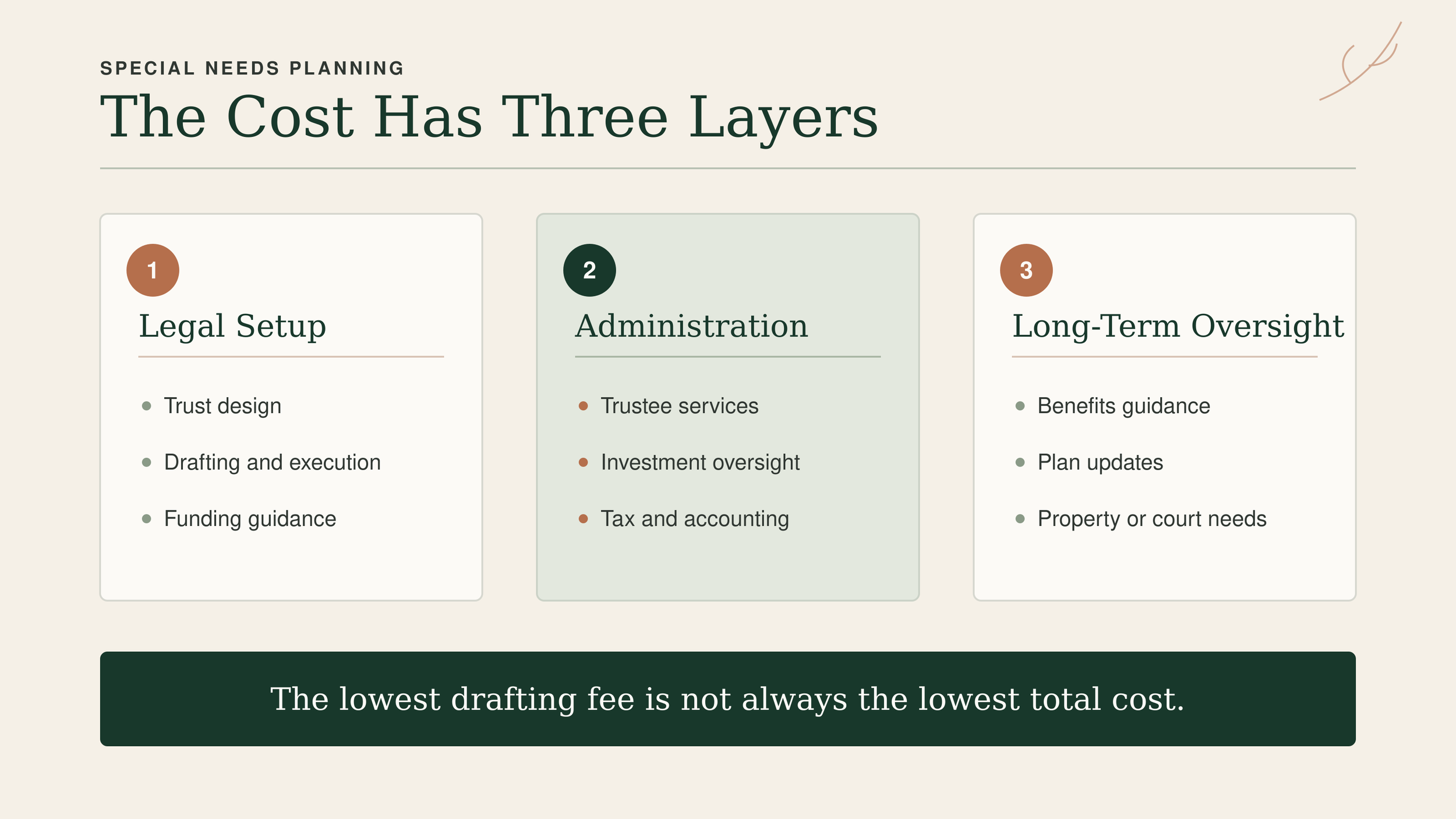
Families often focus on the attorney’s drafting fee and overlook the cost of maintaining the trust. A realistic budget should consider both.
Possible upfront costs
Legal advice, drafting, and execution;
Review of an existing estate plan;
Beneficiary-designation coordination;
Pooled-trust enrollment or joinder fees;
Court filing or approval costs, when applicable;
Trustee onboarding or account-opening fees; and
Advice from a tax professional, financial advisor, or settlement planner.
Possible ongoing costs
Trustee compensation;
Investment-management or custodial fees;
Tax preparation and accounting;
Legal advice regarding distributions or changing benefit rules;
Property-management expenses if the trust owns a home;
Required reporting or court-accounting expenses; and
Trust termination and final-distribution costs.
Not every trust incurs every expense. For example, tax reporting depends on how the trust is structured, how it is funded, and how its income is treated. It is too broad to say that every special needs trust must file a separate income-tax return each year. Some trusts are treated as grantor trusts, while others may have a Form 1041 filing obligation. The IRS instructions for Form 1041 explain the general filing framework, but the trustee should obtain advice based on the particular trust.
How the Three Main Options Compare
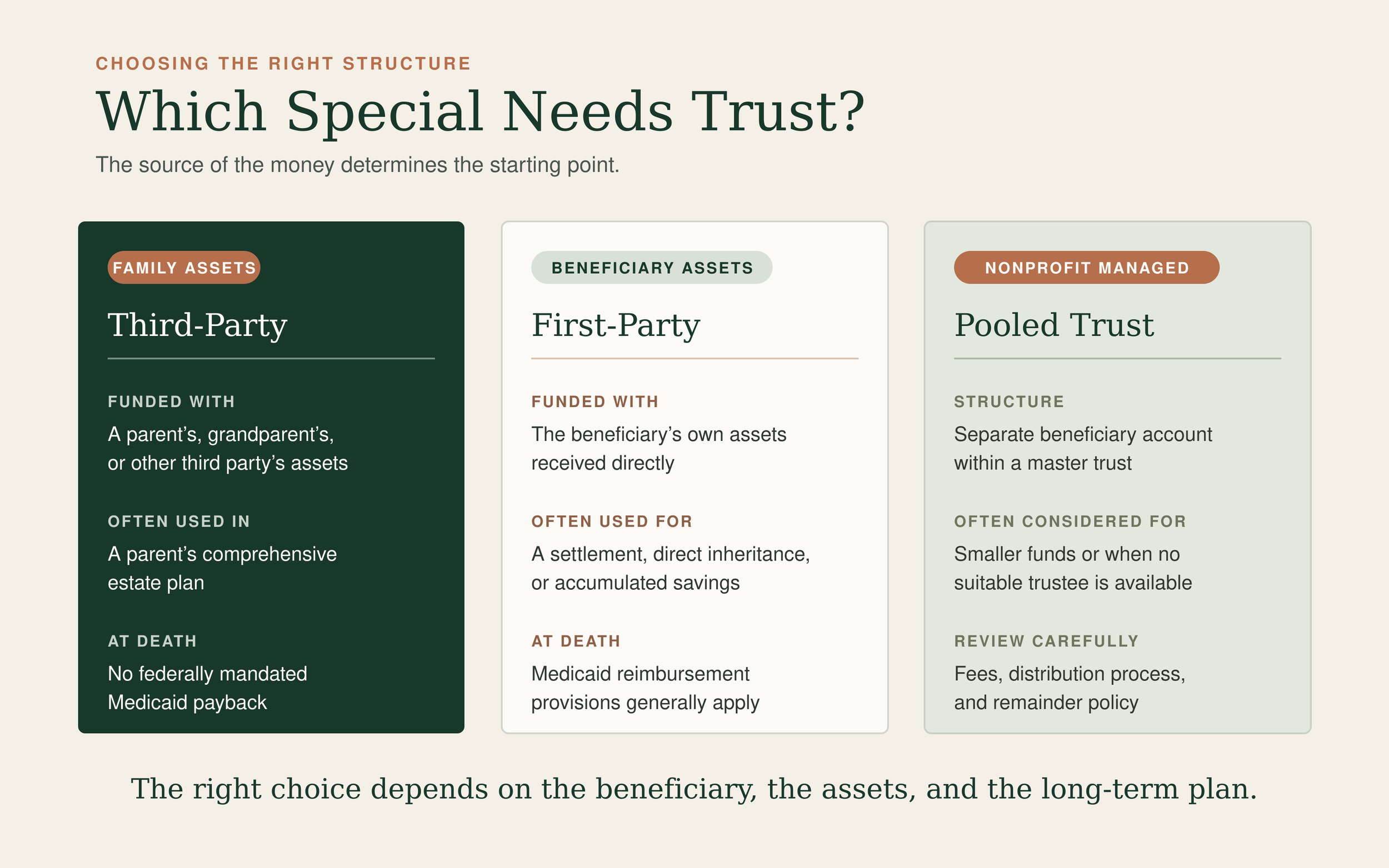
First-party special needs trusts
A first-party trust may be appropriate when a person with a disability receives assets in their own name. Common examples include a lawsuit settlement, an unexpected inheritance, accumulated savings, or a divorce-related property award.
These trusts are sometimes called self-settled or Medicaid-payback trusts. At the beneficiary’s death, the state or states that provided Medicaid benefits may be entitled to reimbursement from the remaining trust assets, subject to the governing law and trust terms. If assets remain after required reimbursement and expenses, they may pass to the remainder beneficiaries named in the trust.
In Georgia, special needs trust matters involving Medicaid are administered through the Georgia Department of Community Health’s Trust Unit. Georgia Medicaid provides current program and contact information here.
Third-party special needs trusts
A third-party trust is generally the preferred planning tool when parents or other relatives are using their own assets to provide for a loved one. Because the assets never belonged to the beneficiary, the federal first-party Medicaid-payback requirement does not apply. The person creating the trust can name the individuals or charities that will receive any remaining assets after the beneficiary’s death.
The trust may be created now as a standalone trust, included in a revocable living trust, or created under a will at death. The right format depends on the family’s assets, privacy goals, funding plan, and desired level of flexibility.
Pooled special needs trusts
A pooled trust is established and managed by a nonprofit organization. The organization maintains a separate account for each beneficiary while pooling funds for investment and administration.
Pooled trusts can be practical when the amount involved is too small to justify a standalone trust with a professional trustee, when no suitable individual trustee is available, or when funds must be placed quickly. They are not automatically the least expensive option in every case. Families should review:
Enrollment or joinder fees;
Minimum funding requirements;
Annual or monthly administration fees;
Distribution-request fees;
Investment expenses;
Policies for homes or other non-cash assets;
The organization’s remainder or Medicaid-payback policy; and
What happens if the beneficiary moves to another state.

What Can a Special Needs Trust Pay For?
A properly administered trust may pay for a broad range of goods and services that support the beneficiary. Depending on the trust and the beneficiary’s benefits, examples may include:
Medical, dental, vision, and therapy expenses not otherwise covered;
Education, tutoring, and vocational training;
Transportation and vehicle modifications;
Assistive technology, computers, and communication devices;
Personal care and companion services;
Recreation, travel, and social activities;
Professional services; and
Home modifications and accessibility improvements.
The distribution rules are more nuanced than a simple list of “allowed” and “prohibited” purchases.
Cash paid directly to an SSI recipient is generally treated as unearned income. Payments made directly to a third-party provider for many non-shelter goods and services generally do not count as income, although the result depends on the item and the beneficiary’s circumstances. Social Security’s trust guidance discusses how different disbursements are treated.
Effective September 30, 2024, Social Security stopped including food in its in-kind support and maintenance calculations. SSA explains that change here. Shelter payments, including certain rent, mortgage, and utility payments, can still reduce SSI. That does not always mean the trustee should refuse to pay them. In some situations, the benefit to the beneficiary may justify the reduction. The trustee should evaluate the practical tradeoff instead of relying on a blanket rule.

ABLE Account vs. Special Needs Trust: Which Costs Less?
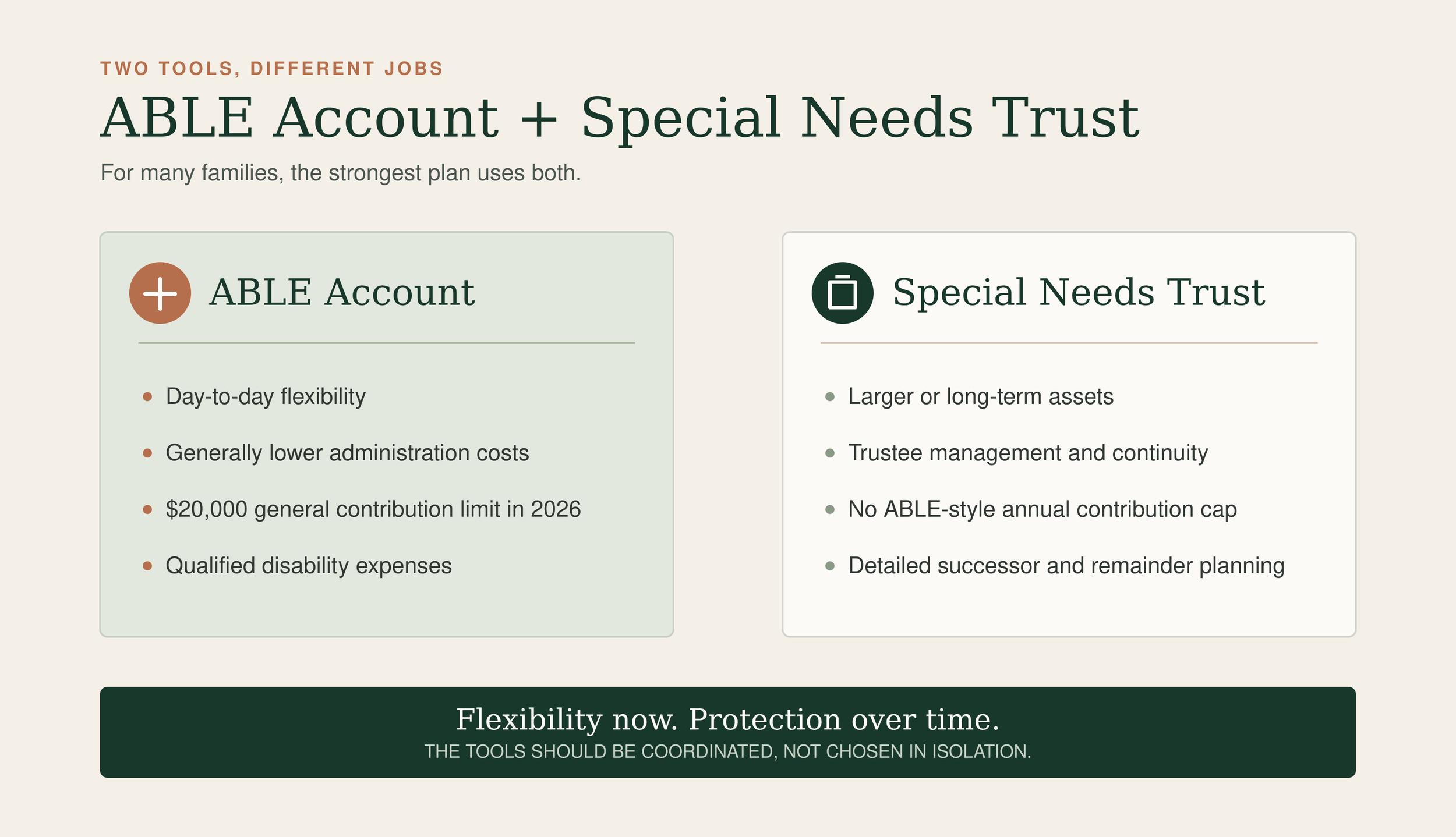
An ABLE account is often less expensive and easier to administer than a special needs trust, but it serves a different role.
Beginning in 2026, an individual may qualify for an ABLE account if the disability began before age 46, an increase from the prior age-26 requirement. The IRS describes the expanded eligibility rule here.
For 2026, the general annual contribution limit is $20,000. An employed beneficiary who meets the statutory requirements may be able to contribute an additional amount based on compensation and the applicable federal poverty-line limit. IRS Revenue Procedure 2025-32 confirms the 2026 base contribution limit.
ABLE accounts offer several advantages:
Low setup and maintenance costs;
Tax-free growth when distributions are used for qualified disability expenses;
Greater day-to-day control for a beneficiary who can manage the account; and
Favorable treatment under SSI and Medicaid rules.
For SSI purposes, up to $100,000 in an ABLE account is generally excluded from countable resources. If the balance above $100,000, together with other countable resources, causes the beneficiary to exceed the SSI resource limit, SSI payments may be suspended while Medicaid eligibility can continue under the ABLE rules. SSA provides current ABLE guidance here.
An ABLE account also has limitations. It has an annual contribution cap, withdrawals must satisfy qualified-disability-expense rules to receive full tax benefits, and state Medicaid-reimbursement rules may apply after the beneficiary’s death.
Many families use both tools: an ABLE account for flexible, day-to-day expenses and a special needs trust for larger inheritances, long-term management, and successor planning. A special needs trust can also transfer funds to the beneficiary’s ABLE account when appropriate.

Can You Create a Special Needs Trust Without a Lawyer?
Online forms may appear less expensive, but the real question is whether the document will work when it matters.
Special needs planning crosses several areas of law: trusts, public benefits, tax, estate planning, fiduciary administration, and sometimes guardianship or settlement law. Common problems with generic or incomplete plans include:
Using the wrong type of trust for the source of the funds;
Giving the beneficiary too much control over the assets;
Omitting required first-party trust provisions;
Naming the beneficiary individually on a retirement account or insurance policy;
Choosing a trustee who cannot administer the trust effectively;
Creating a trust but never coordinating how assets will reach it; and
Relying on distribution language that does not reflect current benefit rules.
The legal fee is not simply for producing a document. It pays for identifying the correct structure, integrating it with the estate plan, explaining how to fund and administer it, and reducing the risk of a costly benefits problem later.

How to Control the Cost Without Cutting Corners
Families can often manage costs by making thoughtful decisions early.
Coordinate the trust with the full estate plan
Review wills, revocable trusts, life insurance, retirement accounts, transfer-on-death designations, and other beneficiary arrangements together. Fixing inconsistent designations after a death or distribution is usually more difficult and expensive.
Choose the trustee based on the job
Compare individual, corporate, and nonprofit pooled-trust options. Ask what services are included, how distributions are handled, and what additional charges may apply. The lowest annual fee is not a bargain if the trustee lacks the experience or availability the beneficiary needs.
Match the structure to the amount involved
A pooled trust may be more practical for a smaller first-party fund. A standalone trust may provide greater flexibility for larger assets, real estate, or long-term family planning.
Create a clear funding plan
An unfunded trust cannot protect an inheritance that is paid directly to the beneficiary. Confirm how life insurance, retirement accounts, investment accounts, and testamentary gifts should be directed.
Keep organized records
Good records reduce accounting, tax-preparation, and legal-review costs. The trustee should retain statements, receipts, distribution requests, tax documents, and communications regarding benefits.
Review the plan after major changes
Review may be needed after a death, divorce, new diagnosis, significant inheritance, settlement, move to another state, change in benefits, or change in the proposed trustee. Periodic review can identify a problem before assets are transferred incorrectly.
The Cost of Not Planning
The most expensive mistake is often leaving assets directly to a beneficiary who receives means-tested benefits.
An inheritance paid outright may count as income when received and as a resource if retained. That can reduce or interrupt SSI and may affect Medicaid eligibility depending on the program. Corrective planning may require a first-party special needs trust, pooled trust, court involvement, or a carefully documented spend-down.
Other costly mistakes include:
Naming the beneficiary directly on life insurance or retirement accounts;
Asking a sibling to hold the beneficiary’s inheritance informally;
Assuming a will alone protects the inheritance;
Selecting a trustee without discussing benefit-sensitive distributions;
Creating a trust but failing to fund it; and
Waiting until a settlement or inheritance has already been distributed.
The goal is not merely to preserve benefits. It is to build a structure that improves the beneficiary’s life, supports the people who will help them, and remains workable for years to come.
Frequently Asked Questions About Special Needs Trust Costs
How much does it cost to set up a special needs trust in Georgia?
Many online estimates place legal drafting fees in the $2,000-to-$5,000 range, but a Georgia trust may cost less or more depending on the type of trust and the work involved. A third-party trust included in a family estate plan, a first-party trust funded with settlement proceeds, and a pooled trust joinder are different services. A consultation and written scope of work provide a more meaningful estimate than a national average.
Are there annual fees for a special needs trust?
There may be. Trustee compensation, investment fees, tax preparation, accounting, legal advice, and property expenses can create ongoing costs. A family member may serve without compensation, but the trust may still need professional tax, investment, or benefits guidance.
Does every special needs trust require Medicaid payback?
No. A properly structured third-party special needs trust funded only with someone else’s assets is not subject to the federal first-party Medicaid-payback requirement. First-party trusts and first-party pooled accounts generally must address Medicaid reimbursement or the pooled trust’s right to retain funds under federal law.
How much money can be placed in a special needs trust?
Special needs trusts do not have the same annual contribution cap that applies to ABLE accounts. The appropriate amount depends on the beneficiary’s expected lifetime needs, other resources, tax considerations, trustee fees, and the trust’s purpose. Gift- and estate-tax consequences may also need to be considered when others fund the trust.
Does a special needs trust earn interest or investment income?
It can. The trustee may invest trust assets under the trust terms and applicable fiduciary standards. Interest, dividends, and capital gains can create tax consequences, so the investment and tax strategy should be coordinated with anticipated distributions and the beneficiary’s needs.
Is a pooled trust always cheaper?
No. A pooled trust can reduce drafting and trustee-administration costs, particularly for a smaller account, but enrollment, recurring administration, distribution, investment, and closing fees vary. The nonprofit’s fee schedule and remainder policy should be reviewed before joining.
Is an ABLE account a substitute for a special needs trust?
Sometimes an ABLE account is sufficient for modest savings and routine qualified disability expenses. It is usually not a complete substitute for a trust when the family expects a larger inheritance, needs long-term trustee management, wants detailed remainder instructions, or must coordinate complex assets. Many plans use both.
Is a Special Needs Trust Worth the Cost?
For many families, yes. A carefully designed special needs trust can protect access to important benefits, provide responsible financial management, and give parents and other relatives a clear way to support a loved one without leaving assets outright.
The right structure depends on whose money will fund the trust, the beneficiary’s age and benefits, the amount and type of assets, the available trustees, and the family’s long-term goals. Cost matters, but it should be evaluated alongside flexibility, administration, and the consequences of getting the plan wrong.
Conner Law Group helps Georgia families coordinate special needs trusts with wills, revocable trusts, powers of attorney, healthcare directives, beneficiary designations, and broader long-term planning. If you would like to discuss the right approach for your family and receive a tailored fee estimate, schedule a complimentary consultation.
This article is provided for general informational purposes and is not legal, tax, investment, or benefits advice. SSI, Medicaid, tax, and trust rules are fact-specific and may change. Consult appropriate professionals regarding your circumstances.
