
What Happens if Someone Dies Without a Will in Georgia?
When someone dies without a Will in Georgia, the law determines who inherits their property. This is called dying “intestate.” Instead of following written instructions left by the person who passed away, Georgia’s intestacy laws provide a default plan for how certain assets are distributed.
For many families, this can come as a surprise. A surviving spouse may not automatically inherit everything. Stepchildren may not be treated the same as biological or legally adopted children under the default rules. Family members may disagree about who should handle the estate. Real estate, bank accounts, personal property, and creditor issues may all require careful attention.
Understanding what happens when there is no Will can help families avoid confusion and take the right next steps during an already difficult time.

What Does It Mean to Die Without a Will?
A person dies without a Will when they pass away without a valid Last Will and Testament. In that situation, Georgia law determines who the legal heirs are and who may be entitled to inherit from the estate.
A Will allows a person to decide who receives their property, who should serve as Executor, and how certain family or financial concerns should be handled. Without a Will, those decisions are no longer made by the individual. They are determined by Georgia law and administered through the probate process when probate is required.

Who Inherits if There Is No Will in Georgia?
Georgia’s intestacy laws generally prioritize a surviving spouse and children first, then other relatives if there is no spouse or children.
Common situations include:
If there is a surviving spouse but no children
The surviving spouse generally inherits the estate.
If there is a surviving spouse and children
The surviving spouse and children generally share the estate. However, the surviving spouse must receive at least one-third of the estate.
This is one of the most common surprises for families. Many people assume that a surviving spouse automatically receives everything. In Georgia, that is not always the case if the person who passed away also had children.
If there are children but no surviving spouse
The children generally inherit the estate. If a child passed away before the parent but left children of their own, those descendants may inherit the share their parent would have received.
If there is no spouse and no children
The estate may pass to other relatives, such as parents, siblings, nieces, nephews, grandparents, aunts, uncles, or more remote relatives depending on the family circumstances.
The exact inheritance path can become more complicated in blended families, estranged family situations, families with deceased relatives, or situations involving incomplete information about heirs.
Does the Estate Still Have to Go Through Probate?
Possibly. Whether probate is required depends on what assets the person owned and how those assets were titled.
Some assets may pass outside of probate, including:
Accounts with valid beneficiary designations
Life insurance payable to a named beneficiary
Retirement accounts with named beneficiaries
Jointly owned property with rights of survivorship
Assets held in a trust
Other assets may require probate before they can be transferred. This often includes individually owned real estate, bank accounts without beneficiaries, vehicles, personal property, or other assets titled solely in the deceased person’s name.
When there is no Will and probate is needed, the probate court may appoint an Administrator to manage the estate.

What Is an Administrator?
An Administrator is the person appointed by the probate court to handle the estate when there is no valid Will naming an Executor.
An Administrator’s responsibilities may include:
Filing probate paperwork
Identifying the legal heirs
Collecting and protecting estate assets
Addressing creditor claims and debts
Maintaining estate records
Handling estate-related tax matters
Distributing assets according to Georgia law
Closing the estate when administration is complete
Because the Administrator has fiduciary duties, this role should be taken seriously. Mistakes during estate administration can create delays, family disputes, or potential liability.
Who Can Serve as Administrator?
In many cases, a surviving spouse or sole heir may have priority to serve. If there are multiple heirs, the heirs may need to agree on who should serve, or the court may need to resolve the issue.
This can become more difficult when heirs disagree, when family members live in different states, or when there are concerns about whether a proposed Administrator can properly handle the estate.
If there is conflict, the probate process may become contested.
What Problems Can Arise When There Is No Will?
Dying without a Will can create practical and legal challenges for the family left behind. Common issues include:
Uncertainty about who should handle the estate
Disputes among heirs
A surviving spouse sharing the estate with children
Complications involving blended families
Difficulty identifying all legal heirs
Delays in accessing assets
Real estate title issues
Questions about debts and creditor claims
Lack of clear instructions regarding personal property
Increased court involvement
Even when family members get along, the lack of a written plan can add unnecessary stress and uncertainty.

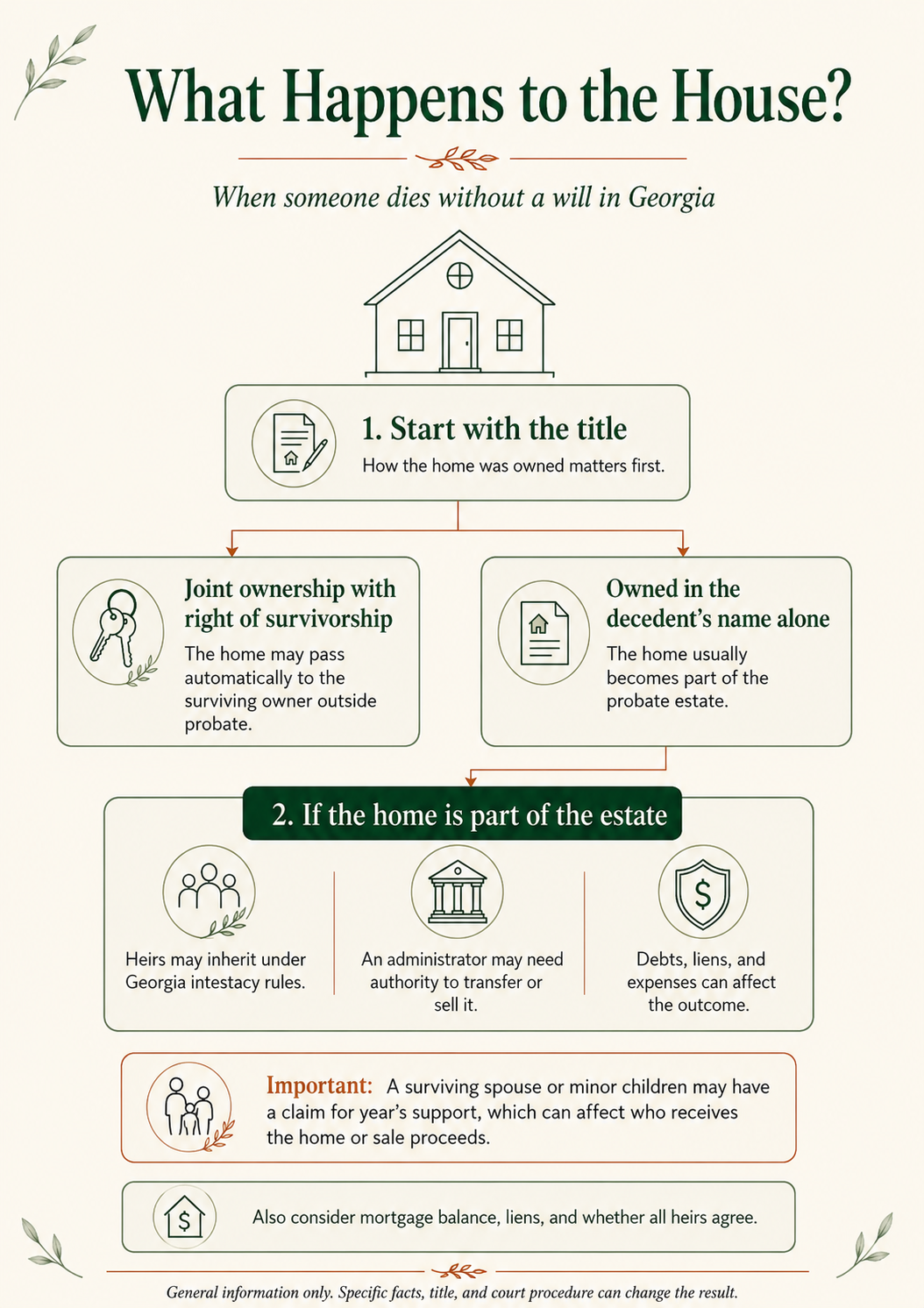
What Happens to the House if There Is No Will?
Real estate is often one of the most important and complicated assets in an intestate estate.
If a home or other real property was owned solely by the person who passed away, probate may be needed to transfer or sell the property. The heirs may have an interest in the property under Georgia law, but an Administrator may still need to be appointed to handle estate administration, creditor issues, and proper transfer of title.
This can become especially complicated if:
Multiple heirs inherit an interest in the property
One family member wants to keep the home
Other heirs want to sell
There is a mortgage or unpaid property taxes
The property needs maintenance
The heirs cannot agree on next steps
Families should be cautious about transferring, selling, or distributing real estate before understanding the probate and title implications.
What About Debts?
When someone dies, their debts do not simply disappear. Valid debts of the estate may need to be addressed before assets are distributed.
This can include:
Medical bills
Credit cards
Funeral expenses
Mortgage payments
Property taxes
Final income tax obligations
Other creditor claims
An Administrator should avoid distributing estate assets too early without understanding the estate’s obligations. Premature distributions can create problems if creditors, taxes, or expenses later need to be paid.
What If Family Members Disagree?
Disagreements are not uncommon when someone dies without a Will. Without written instructions, family members may have different expectations about who should serve, who should receive certain property, whether real estate should be sold, or how quickly distributions should occur.
Some disputes can be resolved through communication, negotiation, or agreement among the heirs. Others may require court involvement.
Common disputes include:
Who should serve as Administrator
Whether an heir is entitled to inherit
How property should be distributed
Whether estate assets are being properly managed
Whether real estate should be sold
Whether someone has taken or used estate property improperly
When disputes arise, it is often helpful to seek legal guidance early before positions become more entrenched.
How Can a Will Help Avoid These Issues?
A properly prepared Will can give clear direction regarding:
Who should serve as Executor
Who should receive property
How personal belongings should be handled
Whether assets should be held in trust
Who should manage inheritances for minor children
How blended family concerns should be addressed
Whether certain people should or should not inherit
A Will does not necessarily avoid probate by itself, but it can make the probate process clearer and reduce uncertainty for surviving family members.
For many families, a Will is part of a broader estate plan that may also include Trusts, Powers of Attorney, Advance Directives for Healthcare, beneficiary designation planning, and special needs planning where appropriate.
What Should Families Do First?
If a loved one dies without a Will in Georgia, families should generally begin by:
Obtaining certified death certificates
Identifying and securing estate property
Looking for any estate planning documents
Gathering financial records
Determining how assets were titled
Identifying potential heirs
Avoiding premature distributions
Consulting with a probate attorney if probate may be needed
Every estate is different. The right next step depends on the assets involved, the family structure, whether there are debts, and whether all heirs are in agreement.
Frequently Asked Questions
-
No. Probate is not always required. Whether probate is necessary depends on the assets involved and how they were owned. Some assets pass by beneficiary designation, joint ownership, or trust planning. Other assets may require probate before they can be transferred.
-
Not always. If the person who passed away had children, the surviving spouse and children generally share the estate, although the spouse must receive at least one-third.
-
If probate is needed, the probate court may appoint an Administrator. The Administrator is responsible for managing the estate and distributing assets according to Georgia law.
-
Agreement among heirs can sometimes make the process smoother. However, probate paperwork, court approval, title issues, creditor matters, and tax considerations may still need to be addressed depending on the estate.
-
Some simple estates may be handled without legal representation, but many families benefit from guidance when there is real estate, multiple heirs, creditor issues, tax concerns, disputes, or uncertainty about whether probate is required.
Guidance Through Georgia Probate and Estate Administration
When someone dies without a Will, families are often left trying to make legal and financial decisions during a difficult time. Georgia’s intestacy laws provide a default plan, but that default plan may not reflect the person’s wishes or the family’s expectations.
Conner Law Group assists families throughout Georgia with probate, estate administration, intestate estates, fiduciary guidance, and related estate matters. If your family is navigating the probate process after a death, our office can help you understand your options and determine the next steps.
