

After a loved one passes away, you may bring a death certificate to the bank expecting to close an account or access funds for estate expenses. Instead, the bank tells you that you need Letters of Administration.
For many families, this is their first indication that a probate court proceeding may be necessary. Understanding what the bank is requesting can help you take the next step with confidence.
What Are Letters of Administration?
Letters of Administration are documents issued by a probate court confirming that someone has been appointed to administer an estate. They provide evidence of that person’s authority to act for the estate, subject to the court’s order and applicable law.
They are not a letter you prepare yourself, and a death certificate alone does not establish that you have authority to manage the deceased person’s assets.
Why Is the Bank Asking for Them?
The bank needs to determine who is legally authorized to access or manage the account.
An account held solely in the deceased person’s name, without an effective payable-on-death beneficiary or other arrangement allowing it to pass outside probate, may need to be handled through the estate.
Being the account owner’s spouse, child, or other close relative does not automatically authorize you to withdraw the money. The bank may need court-issued documents identifying the estate’s representative before it can release funds.
Before starting paperwork, ask the bank to confirm:
How the account is titled.
Whether it has a surviving owner or designated beneficiary.
Exactly which court documents it requires.
Whether it needs a certified copy of those documents.
What If My Loved One Had a Will?
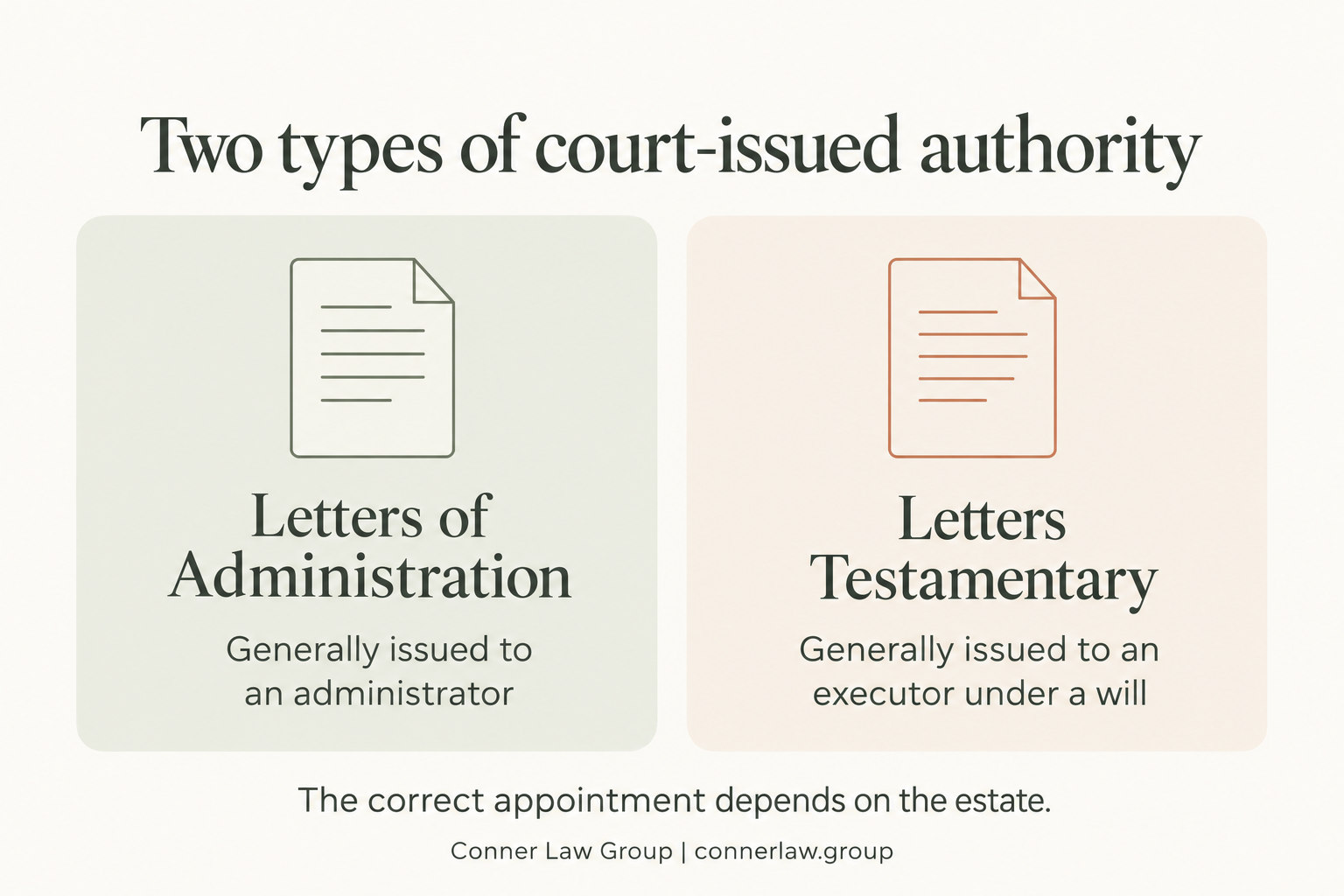
If there is a will naming an executor, the appropriate documents may be Letters Testamentary rather than Letters of Administration.
Letters Testamentary generally confirm the court-appointed executor’s authority. Letters of Administration generally concern an administrator, including situations where someone died without a will. Other circumstances may require a different form of appointment.
Being named executor in a will does not, by itself, give you immediate authority to access the account. The will and the appropriate appointment request generally must be presented to the probate court.
Does Every Bank Account Require Probate?
No. Some accounts may pass directly to a surviving owner or designated beneficiary.
Examples may include:
Accounts with rights of survivorship.
Accounts with valid payable-on-death or transfer-on-death designations.
Accounts properly owned by a trust.
The account agreement, ownership, and beneficiary information matter. Avoid assuming that every jointly held account has the same survivorship terms or that every account requires an estate proceeding.
Where Do I Start?
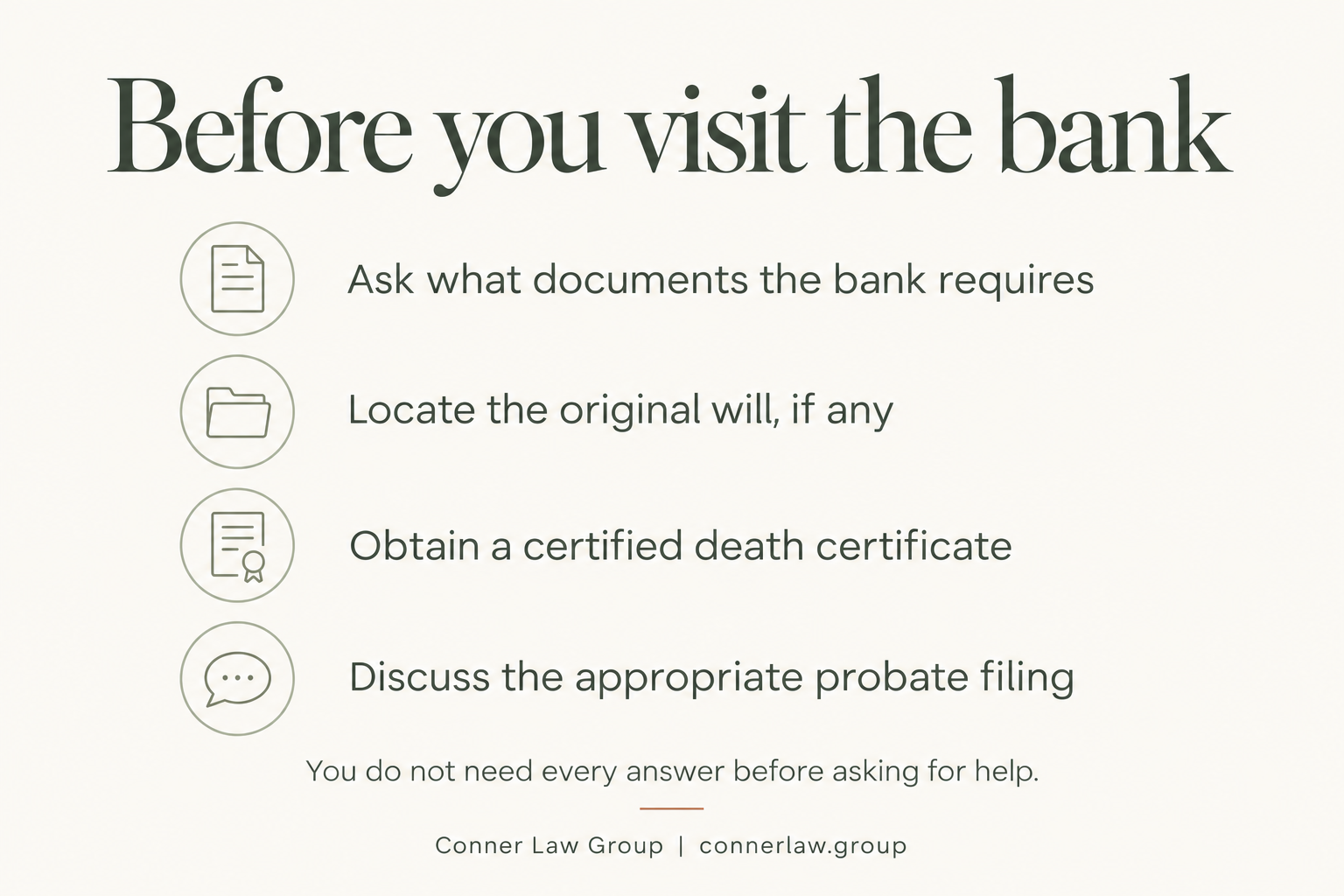
1. Locate the will and death certificate
Find the original will, if there is one, and obtain certified copies of the death certificate. Keep the original will safe and avoid removing staples or making changes to it.
2. Gather basic account and family information
Collect available account statements, the bank’s written requirements, and information about the deceased person’s surviving family members. You do not need a complete inventory before seeking guidance.
3. Identify the appropriate probate court
For a Georgia resident, estate proceedings generally begin in the probate court of the county where the person was domiciled at death. The location of the bank branch does not necessarily determine where to file.
4. Determine the correct procedure
The appropriate filing depends on whether there is a will, who is available to serve, the estate’s assets and obligations, and other circumstances.
An attorney can help determine what the bank needs and which probate procedure fits the situation.
Common Questions
Can I use a power of attorney to access the account after death?
A financial power of attorney generally ends when the person who granted it dies. It does not replace the authority of an executor or administrator after death.
Does having a will mean we can avoid probate?
Not necessarily. A will directs the distribution of assets governed by it, but it does not automatically transfer bank accounts or establish the executor’s authority. Whether probate is needed depends in part on how assets are owned and whether they have effective beneficiary designations.
How long does it take to obtain Letters of Administration?
The timing varies based on the county, the petition, required notices, and whether anyone objects. Obtaining Letters is one stage of estate administration, and the remaining administration may continue afterward.
Can the estate’s money be distributed once Letters are issued?
Appointment does not mean every account can immediately be divided among family members. The representative must address applicable estate obligations and administration requirements before making appropriate distributions.
Should I contact an attorney before gathering every document?
Yes. An initial conversation can help you identify what is needed and avoid spending time on the wrong forms or procedure.
Probate Guidance in Forsyth, Hall, Fulton, and Gwinnett Counties
If a bank has asked you for Letters of Administration or Letters Testamentary, Conner Law Group can help you understand the request, determine the appropriate next steps, and navigate estate administration.
We assist families in Forsyth, Hall, Fulton, and Gwinnett Counties, as well as other Georgia communities.
Schedule a Probate Consultation
Learn more about probate and estate administration at Conner Law Group.
About the Author
Mandy Conner is the founder of Conner Law Group, a Georgia law firm assisting executors, administrators, beneficiaries, and families with probate, estate administration, and related disputes. Her background includes experience with the IRS Office of Chief Counsel.
This article provides general educational information and is not legal advice. The appropriate procedure depends on the circumstances of the estate.
