

Your parent took the time to prepare a will. Now that they have passed away, you may wonder why a bank, financial institution, or title company is still asking for probate documents.
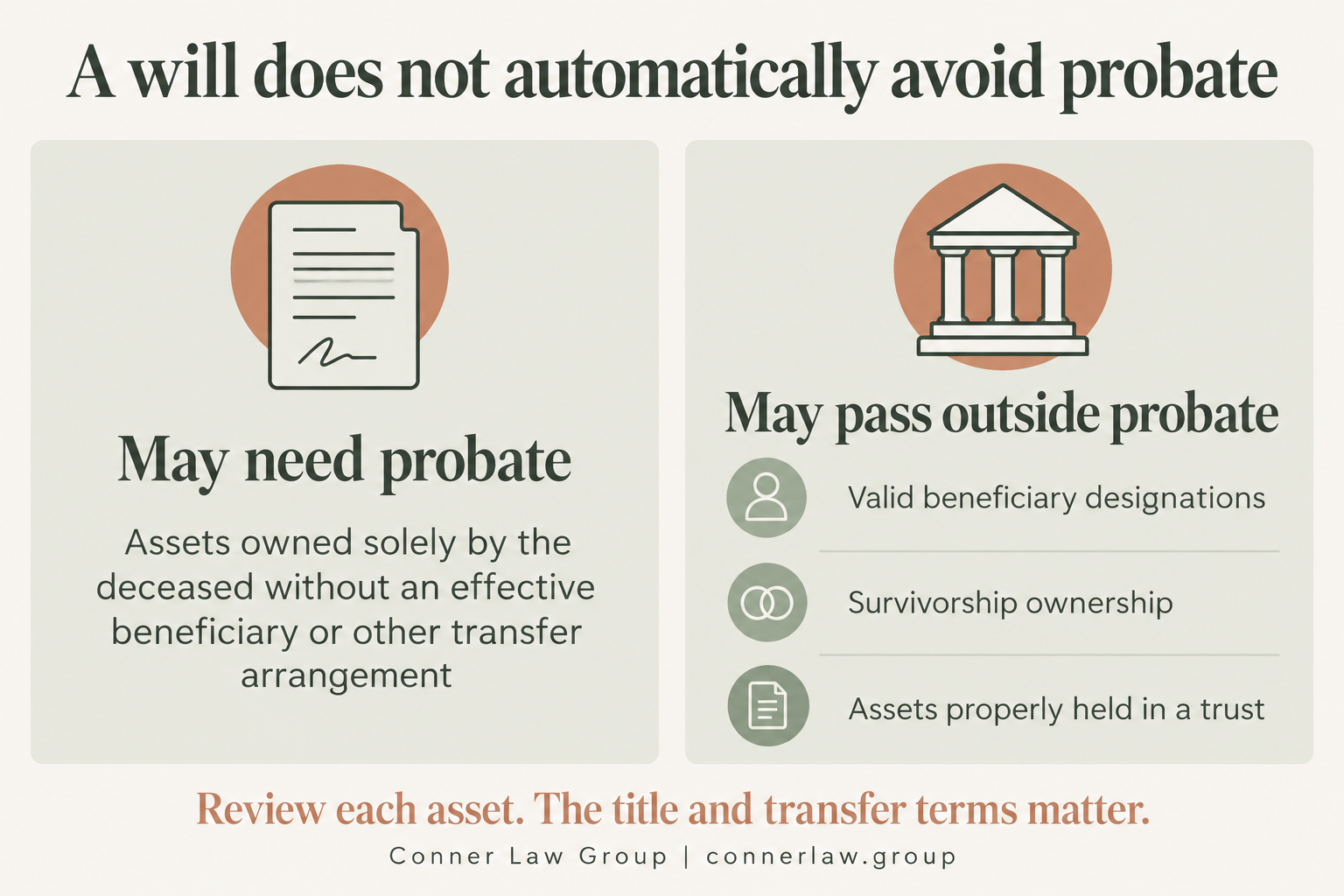
Having a will does not automatically avoid probate in Georgia. Whether an estate needs probate administration depends largely on what your parent owned, how those assets were titled, and whether effective beneficiary designations or other transfer arrangements were in place.
A will and probate serve different purposes. The will states your parent’s wishes for property governed by it. Probate is the court process used to establish the will’s validity and, when needed, authorize someone to administer the estate.
What Does a Will Do After Someone Dies?
A will can identify beneficiaries, nominate an executor, and provide instructions for distributing estate property. It may also create trusts to manage an inheritance for a child, grandchild, or other beneficiary.
However, the will does not automatically change an account’s ownership or give the nominated executor immediate access to estate funds. When court appointment is needed, the executor generally obtains Letters Testamentary as evidence of that authority.
Georgia probate courts explain the process of presenting the original will and seeking probate in their guidance for families whose loved one left a will.
This distinction is also helpful when reviewing your own estate plan. A will addresses what happens after death, while a financial power of attorney and advance directive for health care address decisions during your lifetime. Our article, Estate Planning in Georgia: Three Essential Documents Every Adult Should Have, explains how these documents work together and why each serves a different purpose.
Which Assets May Need Probate?
Assets owned solely by your parent, without an effective arrangement for transfer outside the estate, may require probate. Examples can include:
An individually owned bank account without a surviving designated beneficiary.
Real estate held solely in your parent’s name without another effective transfer mechanism.
Other individually owned property that requires an estate representative to collect, manage, or transfer it.
The account agreement, deed, and beneficiary records matter more than a family’s assumptions about who was supposed to receive an asset.
Which Assets May Pass Outside Probate?
Depending on their terms and the circumstances, these may include:
Bank accounts with valid payable-on-death beneficiaries.
Retirement accounts or life insurance with valid surviving beneficiaries other than the estate.
Property owned with enforceable rights of survivorship.
Assets properly titled in a trust.
Not all joint ownership includes survivorship rights. A beneficiary designation may also fail if the beneficiary died first and no effective alternate designation applies. Each asset should be reviewed individually.
For example, your parent’s life insurance may pass directly to the named beneficiary while a separate bank account must be handled through the estate. One asset passing outside probate does not determine the treatment of everything else.
The University of Georgia explains the relationship between wills and beneficiary-designated property in Where There’s a Will.
For families thinking ahead about their own homes, a Transfer on Death Deed may be another option to discuss. Georgia allows qualifying real estate to pass through this process without ordinary probate administration when the deed and subsequent acceptance requirements are satisfied. However, it does not replace a complete estate plan or address every family’s needs. Read Georgia Transfer-on-Death Deeds: A Useful Tool, Not a Complete Estate Plan for a closer look at the benefits and limitations.
Do We Still Have to File the Will if Everything Passes Outside Probate?
Filing the original will is different from petitioning to probate it or opening an estate administration.
Georgia requires the person holding the will to file it with the appropriate probate court after the person’s death, even when further probate proceedings may not be necessary. Fulton County Probate Court explains this distinction in its decedents’ estates guidance.
Do not discard the will or assume it can remain in a drawer because the known assets have beneficiaries. Confirm the filing requirements and whether additional proceedings are appropriate.
What if the Bank Asks for Letters of Administration Even Though There Is a Will?
Ask the bank to clarify which documents it needs. When a will is admitted to probate and an executor qualifies, the appropriate authority is generally Letters Testamentary.
Different circumstances, including the absence of an available executor, can require a different appointment.
The bank’s request is a useful starting point, but the will and the estate’s circumstances determine the appropriate court filing.
What Should Our Family Do First?
Locate and Protect the Original Will
Keep any codicils, which are amendments to the will, with the original document. Avoid making notes or alterations on the originals.
Obtain Certified Death Certificates
Financial institutions and court filings may require certified copies.
Make a Preliminary Asset List
Include real estate, bank and investment accounts, insurance policies, and other significant property. Note whether each asset appears to have a joint owner or designated beneficiary.
Confirm Ownership and Beneficiaries
Obtain the actual records rather than relying on memory, family expectations, or online account access.
Determine the Appropriate Court Process
For a Georgia resident, the relevant probate court is generally in the county where the person was domiciled at death. An attorney can help determine whether probate administration is needed and which filing fits the circumstances.
Avoid distributing estate property before understanding the representative’s authority and the estate’s obligations. You do not need a complete inventory before asking for guidance.
Common Questions About Wills and Probate in Georgia
If All the Children Agree, Can We Skip Probate?
Family agreement may make administration easier, but it does not by itself replace court authority or transfer title. Whether a proceeding is needed still depends on the assets and the applicable procedure.
Does the Executor Inherit Everything?
No. An executor manages the estate in a fiduciary capacity. Being named executor does not determine what that person inherits. The will and other applicable transfer arrangements govern that question.
Does a Will Override a Bank Account’s Beneficiary Designation?
Generally, a valid beneficiary designation governs the account rather than the will. Any dispute about a designation’s validity requires separate review.
What if We Find an Additional Asset Later?
An asset discovered later may change the steps needed. Keep records of what has been reviewed, and seek guidance if an institution identifies property that remains in your parent’s name.
Should We Contact an Attorney Before Gathering Every Document?
Yes. An initial conversation can help you identify what is needed and avoid spending time on the wrong forms or procedures. Bring what you have, along with your questions.
What if a Beneficiary Receives SSI or Medicaid?
Before distributing an inheritance to someone receiving means-tested benefits, review whether the will includes Special Needs Trust provisions and how those provisions apply. An outright inheritance may affect eligibility, and a trust created under the will does not automatically control assets passing directly through beneficiary designations. Our guide, Special Needs Trusts in Georgia: What Families Need to Know, explains how properly structured planning can help preserve benefits while allowing an inheritance to support a loved one’s quality of life.
Help With Probate in Forsyth, Hall, Fulton, Gilmer, and Gwinnett Counties
Conner Law Group helps executors and families determine whether probate is needed, understand court requirements, and move through estate administration with clear guidance.
If your parent left a will and you are unsure what to do next, we can help you identify the appropriate path.
Schedule a Probate Consultation
Learn more about probate and estate administration at Conner Law Group.
About the Author
Mandy Conner is the founder of Conner Law Group, a Georgia law firm assisting executors, administrators, beneficiaries, and families with probate, estate administration, and related disputes. Her background includes experience with the IRS Office of Chief Counsel.
This article provides general educational information and is not legal advice. The appropriate procedure depends on the estate’s circumstances.
