
No. A financial power of attorney terminates when the person who signed it dies. Even if you handled your parent’s banking and bills for years, you cannot continue using that power of attorney once you know they have died.
The next step depends on how your parent’s assets were owned, whether beneficiaries were named, and whether someone needs to be appointed to administer the estate.
Does a Durable Power of Attorney Continue After Death?
No. “Durable” generally means that a power of attorney can remain effective during the person’s incapacity. It does not mean the document continues after death.
Under O.C.G.A. § 10-6B-10, a financial power of attorney terminates when the principal dies. The principal is the person who signed the document and authorized an agent to act.
For example, you may have been authorized to pay your mother’s bills while she was living. After her death, that same document does not authorize you to withdraw money, transfer her property, or distribute her accounts.
Georgia law includes protections for certain good-faith actions taken without actual knowledge that authority has ended. Those protections do not authorize continued use after you learn of the death.
Who Can Handle Financial Matters After a Parent Dies?
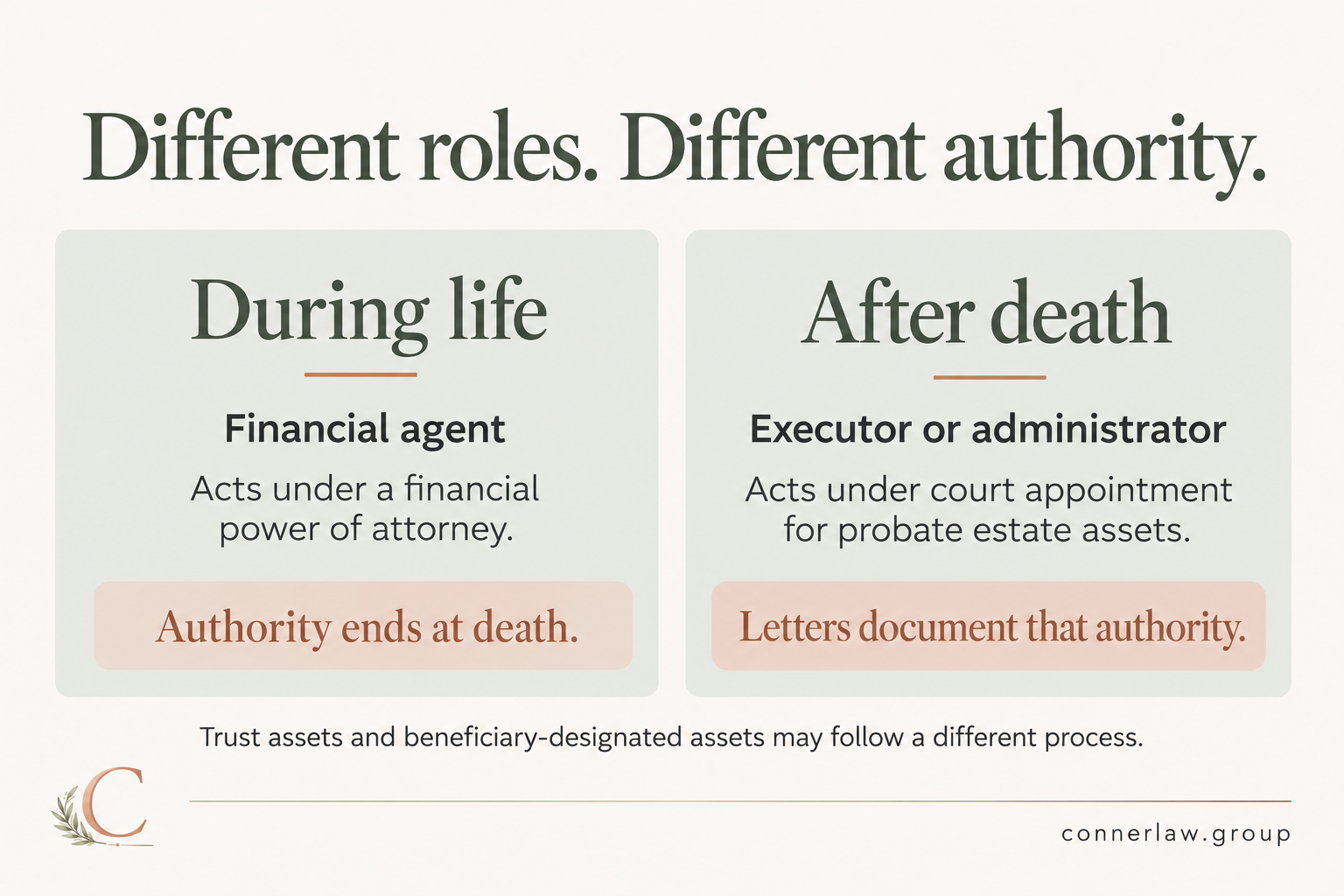
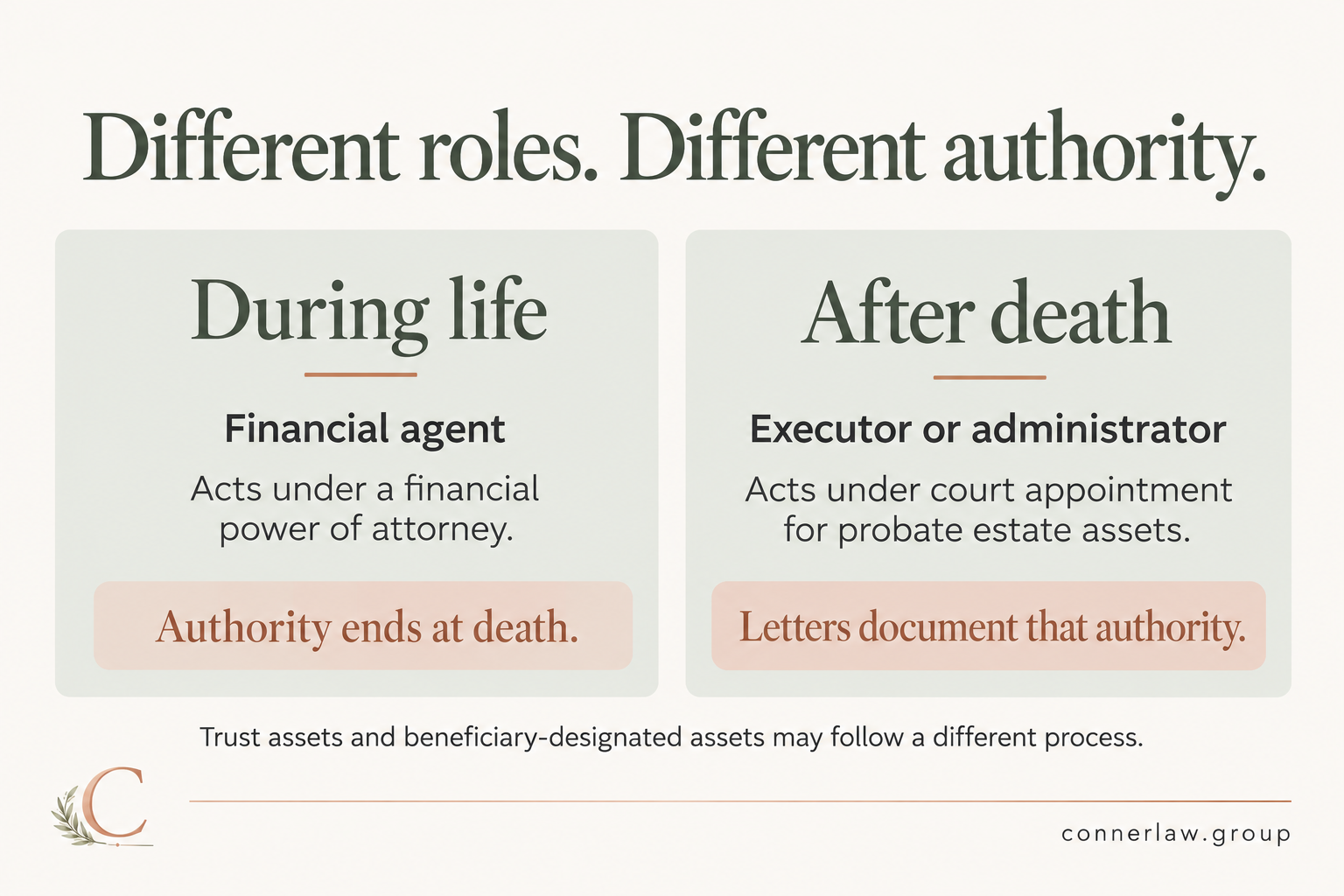
Authority after death depends on the asset and the legal role involved.
An executor or administrator may handle assets belonging to the probate estate. A trustee may manage assets held in a trust. A surviving owner or designated beneficiary may have rights to particular assets under the account documents and applicable law.
Being your parent’s financial agent during life does not automatically make you the executor, administrator, trustee, or beneficiary.
If Your Parent Left a Will
The will may nominate an executor. The nominated person generally must qualify through the probate court before acting as the estate’s appointed representative.
The court issues Letters Testamentary as evidence of an executor’s appointment and authority. If no nominated executor can serve, a different appointment process may be necessary.
If Your Parent Did Not Leave a Will
An eligible person may need to petition the probate court for appointment as administrator. Letters of Administration document that appointment and authority.
Being the surviving spouse, oldest child, or person who previously managed the finances does not, by itself, authorize someone to act for the estate.
The Georgia probate courts’ handbook for personal representatives explains these roles and the court-issued documents that establish authority.
Can I Keep Using My Parent’s Bank Account to Pay Bills?
Do not continue using a power of attorney to access a deceased parent’s account once you know of the death.
Contact the bank, report the death, and ask what documents it requires. The answer may depend on whether the account:
Was owned solely by your parent;
Had a valid payable-on-death beneficiary;
Had a surviving joint owner with applicable survivorship rights; or
Was properly titled in a trust.
Access to a debit card, checkbook, password, or online banking account does not establish legal authority to use the funds.
Likewise, being an authorized signer during your parent’s lifetime does not necessarily make you an owner or give you rights to the account after death.
What If I Need to Pay Funeral Costs or Urgent Bills?
Keep copies of invoices, due dates, and communications. If there is an urgent concern, such as a threatened foreclosure, insurance lapse, or risk of damage to property, seek advice promptly about the available options.
Before paying expenses personally, understand that reimbursement from the estate is not automatic. It may depend on the nature of the expense, available estate funds, legal priorities, and proper documentation.
Do not assume that every bill should be paid immediately or in the order it arrives. A personal representative must consider the estate’s obligations and applicable payment priorities.
What If I Am Also Named Executor?
Your roles are separate.
The power of attorney authorized you to act during your parent’s lifetime. A will may nominate you to serve after death, but nomination does not automatically provide the authority that comes with court appointment.
You may need to submit the appropriate petition, complete qualification requirements, and obtain Letters Testamentary before administering estate assets.
Keeping these roles separate helps avoid confusion with banks, family members, and other institutions.
Does Every Asset Need Probate After the Power of Attorney Ends?
No. The end of a power of attorney does not mean that every asset must pass through probate.
An account with a valid beneficiary designation, property with effective survivorship rights, or an asset properly held in a trust may pass or be administered outside the probate estate.
However, each asset needs to be reviewed individually. A will, a power of attorney, and a beneficiary designation serve different purposes.
Our overview of Georgia probate and estate administration explains how ownership and beneficiary arrangements can affect the next steps.
What Should I Do First?
Gather the Documents
Locate the original will and any codicils, trust documents, death certificates, recent financial statements, deeds, and available beneficiary information.
Keep the former power of attorney and your records of transactions made while serving as agent. Those records may be important during estate administration.
Identify How Assets Were Owned
Make a preliminary list of accounts, real estate, vehicles, business interests, and other property. Note any joint owners, named beneficiaries, or trust ownership.
You do not need a complete inventory before speaking with an attorney.
Notify Financial Institutions
Tell each institution about the death and ask for its written requirements. Keep a record of whom you spoke with and which documents were requested.
Confirm Who Has Authority
Before withdrawing funds, selling property, or making distributions, determine whether the action belongs to an appointed estate representative, trustee, surviving owner, or beneficiary.
How Can Families Plan for This Transition?
A coordinated estate plan addresses both incapacity during life and the administration or transfer of assets after death.
A financial power of attorney can help someone manage finances while you are living. A will addresses the distribution of probate assets and nominates an executor. A properly established and funded trust may provide continuity for trust assets through a successor trustee.
These documents should also coordinate with account ownership and beneficiary designations.
For an overview of lifetime planning documents, read Estate Planning in Georgia: Three Essential Documents Every Adult Should Have.
Frequently Asked Questions
Can a Power of Attorney Be Used After Death to Close a Bank Account?
No. Once you know the account owner has died, you cannot rely on the power of attorney to close the account. Ask the bank what authority and documents are required based on the account’s ownership and beneficiary arrangements.
Does a Durable Power of Attorney Avoid Probate?
A durable financial power of attorney does not transfer assets at death or give the agent continuing authority after death. Whether probate is needed depends on the assets and how they were owned.
Can the Same Person Be Financial Agent and Executor?
Yes, the same person may be selected for both roles. However, authority as financial agent and authority as an appointed executor arise separately and apply at different times.
Does Being the Only Child Give Me Authority Over the Estate?
No. Being the only child does not automatically authorize you to access estate accounts or sell estate property. Whether court appointment is needed depends on the assets and circumstances.
What If My Parent Had a Trust?
Review the trust, successor-trustee provisions, and ownership of each asset. A successor trustee’s authority comes from the trust and applicable law. Assets left outside the trust may require separate attention.
What If I Already Used the Power of Attorney After the Death?
Preserve the transaction records and speak with an attorney promptly. Explain what happened, when you learned of the death, and what funds or property were involved. The appropriate response depends on the circumstances.
Help With the Next Steps After a Parent’s Death
The transition from helping a parent during life to handling an estate can be confusing. You do not need to know which petition to file or have every financial document organized before asking for guidance.
Conner Law Group assists families with probate and estate administration in Forsyth, Hall, Gwinnett, and surrounding Georgia counties.
Schedule a complimentary consultation to discuss your situation and identify the next steps.
About the Author
Mandy Conner is the founder of Conner Law Group, a Georgia law firm assisting executors, administrators, beneficiaries, and families with probate, estate administration, and related disputes. Her background includes experience with the IRS Office of Chief Counsel.
This article provides general educational information about Georgia law and does not create an attorney-client relationship. The appropriate approach depends on the documents, assets, and circumstances involved.
