
Best States for Special Needs Adults: Where Georgia Stands in 2026
If you are searching for the best states for special needs adults, you have probably seen Colorado, California, Massachusetts, Minnesota, and New Jersey near the top of national rankings. Those rankings are useful, but they do not answer the question many Georgia families are actually asking:
Should we move to another state for better disability services, or can we build a strong plan here in Georgia?
The answer depends on more than a ranking. Families need to compare Medicaid waiver access, SSI and SSDI benefits, employment support, housing costs, transportation, healthcare, family support, and legal planning tools. A state with higher benefits may also have much higher housing costs. A state with strong programs may still have long waitlists. A lower-ranked state may be more workable if your family support system, providers, and legal planning are already in place.
This guide explains the national landscape, identifies the factors that matter most for adults with disabilities, and takes a practical look at where Georgia stands.

Why State Choice Matters for Special Needs Adults
Where a special needs adult lives can affect nearly every part of daily life. State programs influence access to healthcare, community-based services, employment support, transportation, housing, and supplemental income.
The federal government provides important baseline programs, including Supplemental Security Income, Social Security Disability Insurance, Medicaid, Medicare, and federal disability protections. But states make many of the decisions that determine how accessible those benefits are in practice.
For example, Medicaid waiver programs are administered at the state level. These waivers can help eligible adults with intellectual or developmental disabilities receive services in home and community settings instead of institutional care. But waiver availability, eligibility procedures, services, and waitlists vary significantly from state to state.
The same is true for transportation. A state may look strong on paper, but if paratransit options are limited or unreliable in the county where your family lives, the adult with disabilities may still be isolated. Housing costs, employment opportunities, weather, provider availability, and family support all matter.
That is why the “best” state is not always the highest-ranked state. The best state is the one where the adult’s medical, financial, legal, and daily support needs can realistically be met.
Top-Ranked States for Special Needs Adults
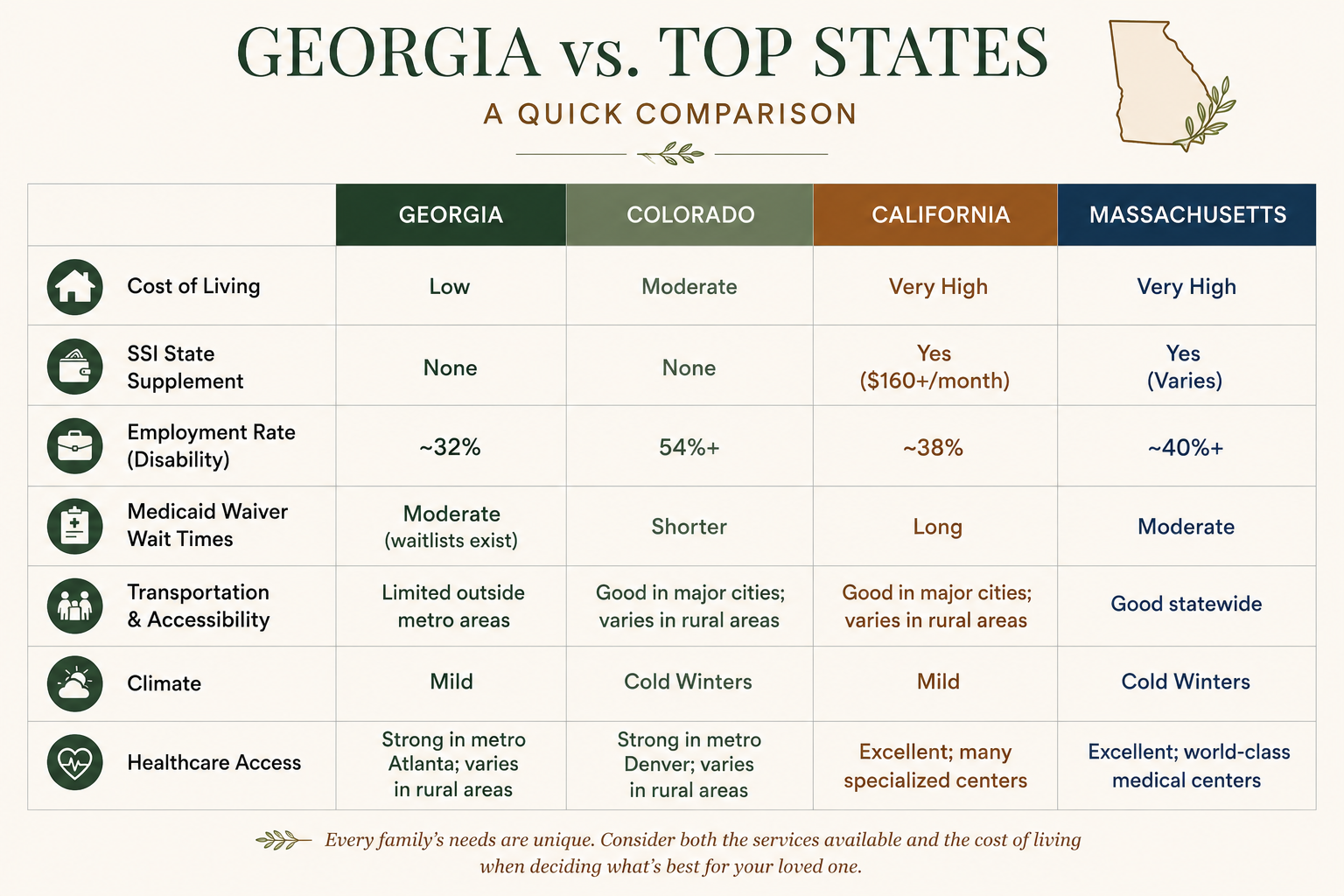
National rankings can provide a useful starting point. AAA State of Play ranked Colorado as the most disability-friendly state in its analysis, citing factors such as employment, education, poverty rates, healthcare, accessibility, and digital accessibility standards. Colorado’s employment rate for people with disabilities was reported at more than 54 percent, one of the strongest results in the country.
Colorado is often attractive because of its employment outcomes, disability access initiatives, and quality-of-life reputation. For some families, it may be an excellent fit. But housing costs, winter weather, and distance from existing family support may make it less practical for others.
California often performs well because of its legal protections, healthcare infrastructure, and state supplemental benefits for some SSI recipients. The trade-off is cost of living. Housing, utilities, taxes, and daily expenses can be much higher than in Georgia, which may reduce the practical value of higher state benefits.
Massachusetts is another strong state for healthcare access, wages, and disability support. It may be particularly attractive for families who need specialized medical care in or near Boston. But again, cost of living is a major factor.
Minnesota and New Jersey also tend to rank well for disability support, community services, and access to major healthcare systems. Minnesota’s climate may be difficult for individuals with mobility or respiratory issues, while New Jersey’s housing costs may be a barrier for some families.
The point is not that these states are bad choices. They are often strong choices. The point is that relocation should be evaluated carefully. A move that improves one category may create new problems in housing, transportation, family caregiving, or provider continuity.
How to Evaluate a State for a Special Needs Adult
Before deciding whether to stay in Georgia or move elsewhere, families should look at five key factors.
1. Medicaid Waivers and Community-Based Services
For many adults with intellectual or developmental disabilities, Medicaid waiver services are more important than state rankings. These programs may provide support for daily living, community access, employment services, respite care, residential support, and other services that help adults live outside institutional settings.
In Georgia, the two major waivers for individuals with intellectual and developmental disabilities are the New Options Waiver Program, known as NOW, and the Comprehensive Supports Waiver Program, known as COMP. Georgia describes these waivers as programs for eligible individuals who meet Medicaid and disability-related criteria and who require the level of care provided in an intermediate care facility.
Georgia still has significant demand for NOW and COMP waiver services. The Georgia Council on Developmental Disabilities reported in 2026 that thousands of Georgians remained on the DBHDD waiting list for services. Families should not assume waiver access will be immediate.
Before relocating, ask these questions:
Does the state have a waiver that fits the adult’s diagnosis and support needs?
How long is the waitlist?
Are services available in the specific county or region where the family plans to live?
Are providers actually accepting new clients?
What happens if the adult moves from one state Medicaid system to another?
A state may have a strong waiver program overall, but the practical result depends on eligibility, timing, provider capacity, and local availability.
2. SSI, SSDI, and State Supplemental Payments
SSI and SSDI are federal programs, but some states add supplemental SSI payments. Those state supplements can matter, especially for adults with limited income.
For 2026, the federal SSI payment standard is $994 per month for an eligible individual and $1,491 per month for an eligible couple. (source) These figures are federal maximums, and actual payment amounts can vary based on income, living arrangement, and other factors.
Georgia does not provide the type of broad state SSI supplement that some higher-benefit states offer. That is a disadvantage for some families. However, Georgia’s lower cost of living may offset part of that gap, especially for families who own a home, have manageable housing costs, or live outside the most expensive metro areas.
The practical question is not just “Which state pays more?” The better question is:
After housing, transportation, healthcare, caregiving, and taxes, where does the adult have the most stable quality of life?
3. Employment and Vocational Support
Employment support varies widely by state. Some adults with disabilities need job coaching, supported employment, vocational rehabilitation, transportation assistance, or workplace accommodations. Others may need day programs, volunteer opportunities, or community engagement rather than traditional employment.
Colorado’s high employment rate for people with disabilities is one reason it ranks well nationally. Georgia’s employment outcomes are not as strong, but families should evaluate the specific local resources available through vocational rehabilitation, community providers, nonprofits, and county-level support programs.
For a special needs adult who wants to work, families should ask:
What vocational rehabilitation services are available?
Are there supported employment providers nearby?
Are employers in the area experienced with disability accommodations?
Can the adult get to work safely and reliably?
Are there community-based day or transition programs if competitive employment is not realistic?
Employment support is not only about income. It also affects autonomy, confidence, structure, social connection, and long-term quality of life.
4. Housing and Cost of Living
Housing may be the deciding factor for many families. Some of the highest-ranked states for disability services also have very high housing costs. That can make it difficult for a special needs adult to live independently or for parents to preserve long-term financial stability.
Georgia’s lower cost of living is one of its strongest practical advantages. Housing costs vary significantly between metro Atlanta, suburban counties, North Georgia, coastal Georgia, and rural areas, but many Georgia families will find that disability income stretches further here than it would in California, Massachusetts, or New Jersey.
Families should consider:
Can the adult afford supported or independent housing?
Will parents or relatives provide housing?
Is the home accessible or capable of being modified?
Are services available near affordable housing?
Would moving increase housing costs so much that higher benefits are canceled out?
For many families, the best plan may be staying in Georgia while using trusts, ABLE accounts, benefits planning, and family support to create a more stable long-term structure.
5. Transportation, Healthcare, and Daily Accessibility
Transportation can determine whether services are actually usable. A special needs adult may technically qualify for healthcare, employment support, or community programs, but if transportation is unavailable, unreliable, or too expensive, access is limited.
In metro Atlanta, MARTA provides public transit and paratransit services in its service area. Outside the metro area, options may be more limited. Many suburban and rural Georgia families still rely heavily on private vehicles.
Healthcare access is also location-specific. Atlanta offers access to major hospitals and specialists, but families in smaller communities may need to travel for certain providers.
Georgia’s mild climate can be an advantage for some adults with mobility limitations, seizure disorders, respiratory conditions, or other conditions affected by ice, snow, and extreme winter weather. Climate should not be the only factor, but it is a practical daily-life consideration.
Where Georgia Stands for Special Needs Adults
Georgia is not usually listed among the top five states for adults with disabilities. That should be acknowledged honestly. Families looking for maximum state supplemental SSI payments, the highest disability employment rates, or the strongest national ranking may find better options elsewhere.
But Georgia deserves a closer look for families who already live here.
Georgia’s strengths include:
Lower cost of living compared with many top-ranked states
Mild winters
Access to major healthcare systems in metro Atlanta
NOW and COMP waiver programs for eligible individuals with intellectual and developmental disabilities
Georgia STABLE accounts for disability-related savings
A growing network of special needs planning, elder law, Medicaid planning, and estate planning attorneys
Strong family and community networks for many residents
Georgia’s challenges include:
Significant waiver demand and waiting lists
Limited public transportation outside metro areas
Lower employment outcomes for people with disabilities compared with top-ranked states
No broad state SSI supplement comparable to some higher-benefit states
Uneven access to services between metro, suburban, and rural areas
For some families, Georgia will not be the best fit. For others, Georgia may be the most realistic and sustainable option, particularly when the family already has housing, providers, relatives, schools, churches, community organizations, or local support systems in place.
Georgia Disability Planning Tools Families Should Know
Legal and financial planning can make a significant difference for Georgia families. The right plan cannot create waiver slots or eliminate every service gap, but it can protect eligibility, preserve assets, and reduce crisis-driven decision-making.
Special Needs Trusts
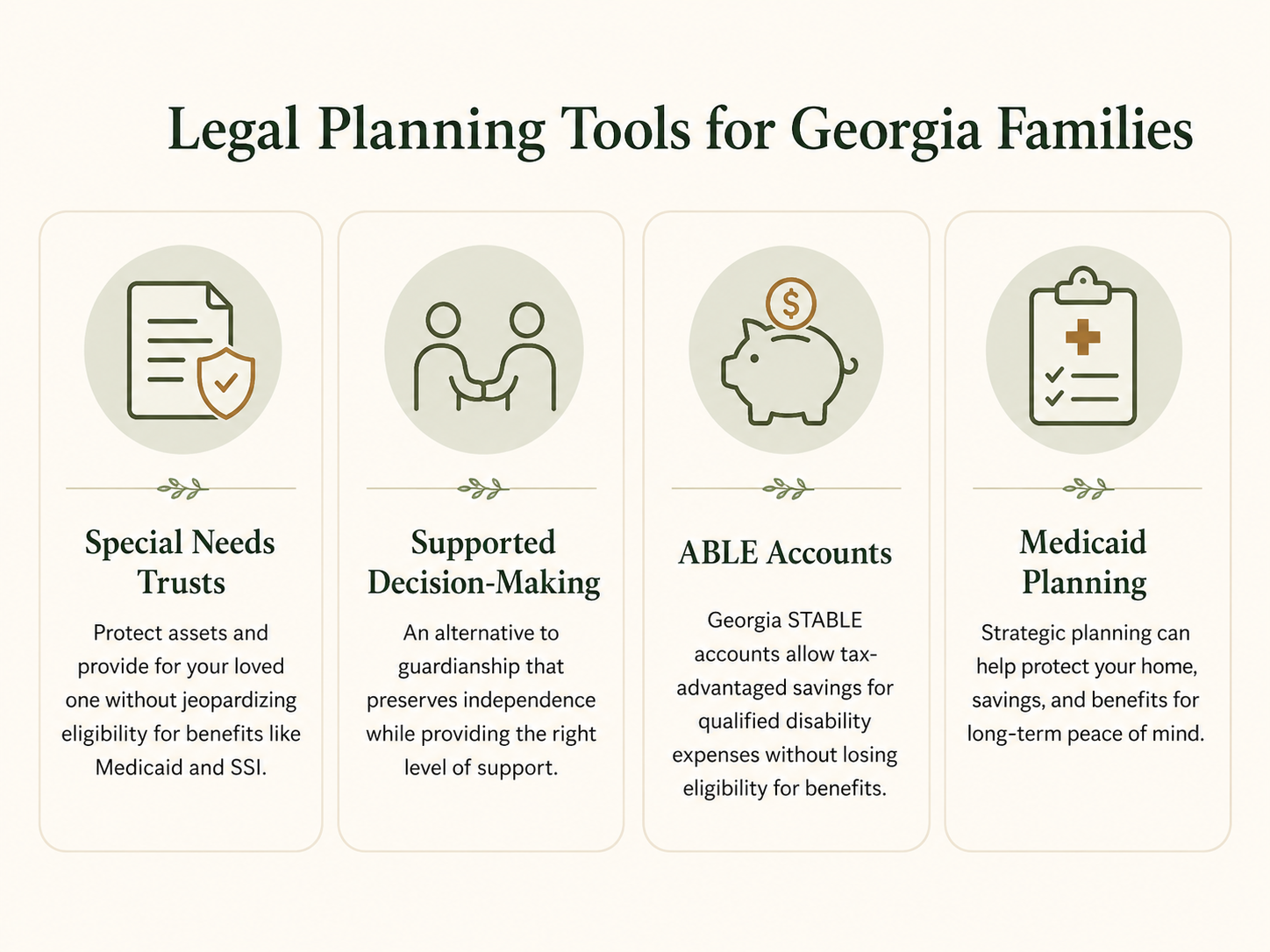
A special needs trust can hold assets for a disabled adult without automatically disqualifying that person from means-tested benefits such as Medicaid or SSI. The trust can pay for supplemental needs that improve quality of life while preserving access to essential public benefits.
Georgia families commonly use two types of special needs trusts.
A third-party special needs trust is funded with assets belonging to someone other than the beneficiary, such as parents, grandparents, or other relatives. This is often used in estate planning so that an inheritance does not pass directly to the disabled adult.
A first-party special needs trust is funded with the beneficiary’s own assets, such as a personal injury settlement, back payment, or inheritance already received directly. These trusts have stricter rules and generally require Medicaid payback provisions.
Choosing the wrong trust structure can create serious benefit problems. Families should work with an attorney who understands special needs trusts, Medicaid, SSI, and Georgia planning issues.
Georgia STABLE Accounts
Georgia’s ABLE program is called Georgia STABLE. A Georgia STABLE account allows eligible individuals with disabilities to save and invest money for qualified disability expenses without automatically losing eligibility for benefits such as SSI or Medicaid.
ABLE accounts can be useful for expenses such as education, housing, transportation, assistive technology, health-related costs, employment support, and other qualified disability expenses. They are often used alongside, not instead of, a special needs trust.
A special needs trust may be better for larger inheritances or long-term family planning. A Georgia STABLE account may be better for day-to-day savings and qualified expenses. Many families use both.
Guardianship and Supported Decision-Making
Guardianship is not always the right answer. Some adults with disabilities need a legal guardian to make major decisions. Others can make many decisions independently with support from trusted people.
Supported decision-making can preserve more autonomy while still giving the adult help with medical, financial, educational, housing, or employment decisions. Powers of attorney, advance directives, representative payee arrangements, HIPAA authorizations, releases, and supported decision-making agreements may all be part of the broader planning conversation.
The right structure depends on the adult’s capacity, needs, risks, preferences, family dynamics, and available support.
Medicaid Planning
Medicaid planning is critical for many Georgia families. A modest inheritance, settlement, or account balance can create eligibility problems if it is not handled correctly.
Families should plan before a crisis. Waiting until a parent dies, a caregiver becomes ill, or a disabled adult receives money directly can limit options. A coordinated plan may include a special needs trust, Georgia STABLE account, beneficiary designation review, guardianship or decision-making documents, and a clear care plan.
Should Georgia Families Move for Better Disability Services?
Sometimes moving is the right decision.
A family may consider relocating if the adult needs highly specialized medical care available only in another region, if waiver access is clearly stronger in another state, if employment support is a top priority, or if the family has another strong support network elsewhere.
But moving can also create disruption. Families may lose local providers, relatives, school transition teams, church communities, therapists, doctors, housing stability, and informal caregivers. Medicaid eligibility and waiver access do not simply transfer seamlessly from one state to another. A move may require new applications, new waitlists, new documentation, and new providers.
Before moving, families should compare:
Current Georgia services and waitlists
Services and waitlists in the destination state
Housing costs
Transportation access
Provider availability
Family support
Healthcare continuity
Legal planning requirements
Tax and benefits implications
A higher-ranked state is not automatically a better state for your family. A lower-ranked state is not automatically the wrong state. The decision should be practical, individualized, and grounded in the adult’s actual support needs.
Frequently Asked Questions
What are the best states for special needs adults?
Colorado, California, Massachusetts, Minnesota, and New Jersey often rank highly in national disability-support rankings. These states tend to perform well on factors such as employment, healthcare, accessibility, wages, legal protections, or community support. However, the best state for a particular adult depends on cost of living, waiver access, family support, transportation, medical needs, and housing.
Is Georgia a good state for special needs adults?
Georgia can be a good state for some special needs adults, especially families who value lower cost of living, mild climate, existing support networks, and access to metro Atlanta healthcare resources. Georgia also offers NOW and COMP waivers for eligible individuals with intellectual and developmental disabilities and Georgia STABLE accounts for qualified disability-related savings. The trade-offs include waiver waitlists, limited transportation outside metro areas, and fewer supplemental income benefits than some other states.
Does Georgia have Medicaid waivers for adults with disabilities?
Yes. Georgia has NOW and COMP waivers for eligible individuals with intellectual and developmental disabilities. These waivers can help provide home- and community-based services, but families should understand eligibility requirements, documentation needs, provider availability, and waitlist issues.
What is a Georgia STABLE account?
Georgia STABLE is Georgia’s ABLE account program. It allows eligible individuals with disabilities to save and invest money for qualified disability expenses while preserving eligibility for certain means-tested benefits, including SSI and Medicaid. It can be a useful planning tool, especially when coordinated with a special needs trust.
Is an ABLE account the same as a special needs trust?
No. An ABLE account and a special needs trust are different tools. An ABLE account is often useful for day-to-day disability-related expenses and modest savings. A special needs trust is often better for inheritances, settlements, or larger long-term planning. Many families use both.
Should parents leave money directly to a disabled adult child?
Usually, no. A direct inheritance can jeopardize SSI, Medicaid, or other means-tested benefits. Parents should consider a third-party special needs trust so assets can be used for the child’s benefit without causing unnecessary benefit loss.
Is guardianship required for a special needs adult in Georgia?
Not always. Guardianship may be appropriate when an adult cannot make or communicate important decisions safely. But less restrictive alternatives may work in some cases, including supported decision-making, powers of attorney, advance directives, representative payee arrangements, HIPAA authorizations, and other legal tools.
Final Takeaway: Planning Matters More Than Rankings
National rankings are helpful, but they should not control your family’s decision. The best state for a special needs adult is the state where healthcare, housing, benefits, transportation, employment, family support, and legal planning work together.
For some families, that may mean moving to a higher-ranked state. For others, it may mean staying in Georgia and building a stronger plan here.
The most important step is not chasing a ranking. It is making sure the adult with disabilities has a coordinated legal and financial plan. That may include a special needs trust, Georgia STABLE account, Medicaid planning, supported decision-making documents, guardianship review, and updated estate planning for parents and caregivers.
If your family is trying to protect a special needs adult in Georgia, Conner Law Group can help you evaluate the legal planning tools available and create a plan designed around your family’s actual needs.
