
Georgia Estate Planning and Probate: A Complete Guide for Young Adults and Middle-Aged Adults
If you are under 50, the phrase "Georgia estate planning and probate" probably sounds like something you can put off for another decade or three. You might think estate plans are for retirees with beach houses, or for families with names on buildings. That assumption is common, and it is also dangerous.
Estate planning is not about how much money you have or how old you are. It is about who raises your children if you cannot, who makes medical decisions if you are incapacitated, and whether your family spends a year in probate court after your death. This guide walks through what Georgia law actually says about wills, trusts, probate, and the documents every adult in this state should have in place, with a focus on the realities facing Georgians in their 30s and 40s.
In Georgia, every adult should consider having at least a will, durable financial power of attorney, advance directive for healthcare, HIPAA authorization, and updated beneficiary designations. Parents of minor children should also name guardians in a will. Some families also benefit from a revocable living trust, especially if they own real estate in multiple states, want privacy, have blended family concerns, or want to reduce probate court involvement.

Why Estate Planning Matters for Young and Middle-Aged Adults in Georgia
Georgia law has a default estate plan for every resident who dies without one. The problem is that you would probably never choose it. Under Georgia Code Title 53, the state's intestacy laws dictate exactly who inherits your property and in what order. If you are married with children, your spouse and children split the estate. If you are unmarried with a partner of 15 years, that partner receives nothing. If you have stepchildren you raised from infancy, they receive nothing unless you legally adopted them. The state's formula is rigid, and it does not care about your actual relationships or verbal promises.
For parents of minor children, the stakes are even higher. Without a will naming a guardian, a Georgia probate court decides who raises your kids. A judge who has never met your family will make that call based on petitions from relatives, and the outcome may not align with your values or wishes. This is the single most overlooked risk for parents under 40, and it is entirely avoidable with a properly executed will.
Many Georgians in their 30s and 40s belong to what financial planners call the sandwich generation: raising young children while also managing care responsibilities for aging parents. This dual pressure makes incapacity planning urgent. A durable power of attorney and an advance directive for healthcare ensure that someone you trust can manage your finances and medical decisions if a car accident, stroke, or sudden illness leaves you unable to speak for yourself. Without these documents, your family may need to petition a probate court for guardianship, a public, expensive, and emotionally draining process.
Georgia imposes no state estate tax, which is good news. However, the federal estate tax exemption, which sits at roughly $15 million per individual in 2026, still matters for those with growing assets: a primary residence in metro Atlanta, retirement accounts, business interests, or investment properties. Proper planning also avoids unnecessary income tax consequences for beneficiaries who inherit retirement accounts under the SECURE Act's 10-year distribution rule.
Georgia Probate: What You Need to Know Before You Plan

The Probate Process in Georgia
Probate is the court-supervised procedure for validating a will, paying creditors, and transferring assets to heirs. In Georgia, probate courts operate at the county level, which means the experience varies depending on where you live. The probate court in Fulton County handles a different volume and moves at a different pace than the probate court in a rural South Georgia county. Filing fees, local rules, and judicial timelines all differ.
The process typically takes six to twelve months for a straightforward estate. If the will is contested, if creditors make claims, or if the estate includes complex assets like a business, probate can stretch to eighteen months or longer. During that time, the estate's assets are effectively frozen. Your family cannot sell real property, access bank accounts, or distribute personal belongings without court approval. Probate is also public. Anyone can walk into the courthouse and read your will, see what you owned, and learn who inherited it.
If you die without a will, Georgia's intestacy statute controls. The order of inheritance follows a strict hierarchy: a surviving spouse and children come first, then parents, then siblings, then more distant relatives. If no living relatives can be found, the estate escheats to the state. This hierarchy creates particular problems for unmarried couples and blended families, where the people you love most may have no legal claim to your assets.
Georgia does not use a broad “small estate affidavit” in the same way some states do. Instead, heirs may be able to use a Petition for Order Declaring No Administration Necessary when the decedent died without a will, no personal representative has been appointed, and the heirs agree on how the estate should be divided. Georgia also has a separate bank-deposit affidavit procedure for certain intestate estates when the only asset being claimed is a small bank deposit. These shortcuts are fact-specific, so families should confirm whether a full probate administration is actually required.
How to Avoid Probate in Georgia
The most effective tool for probate avoidance in Georgia is a funded revocable living trust. When you transfer assets into a trust during your lifetime, those assets are no longer part of your probate estate. When you die, the successor trustee distributes them directly to your beneficiaries according to the trust's terms, with no court involvement, no public filings, and no months-long delay.
Joint ownership with right of survivorship offers another path around probate for certain assets. Real estate titled jointly, joint bank accounts, and jointly held investment accounts pass automatically to the surviving owner. This approach works well for married couples but carries significant risks in blended families. If you add a child from a prior marriage as a joint owner on your home, that child becomes a co-owner immediately, exposing the property to their creditors, divorce proceedings, or personal decisions.
Beneficiary designations on life insurance policies, retirement accounts, and payable-on-death bank accounts also bypass probate. These designations override whatever your will says, which is why reviewing them regularly is critical. Many people name a beneficiary when they open an account and never update it, leaving assets to an ex-spouse or a deceased parent.
For Georgia residents who own property in other states, probate avoidance is especially valuable. If you own a mountain cabin in North Carolina or a beach condo in Florida, your family may face ancillary probate in each state where you held real estate. A trust eliminates that burden by holding all out-of-state property in a single entity that transfers without court proceedings in any jurisdiction.
Essential Estate Planning Documents for Georgia Residents
A complete Georgia estate plan includes several documents that work together. Each serves a distinct purpose, and gaps between them can undermine the entire plan.
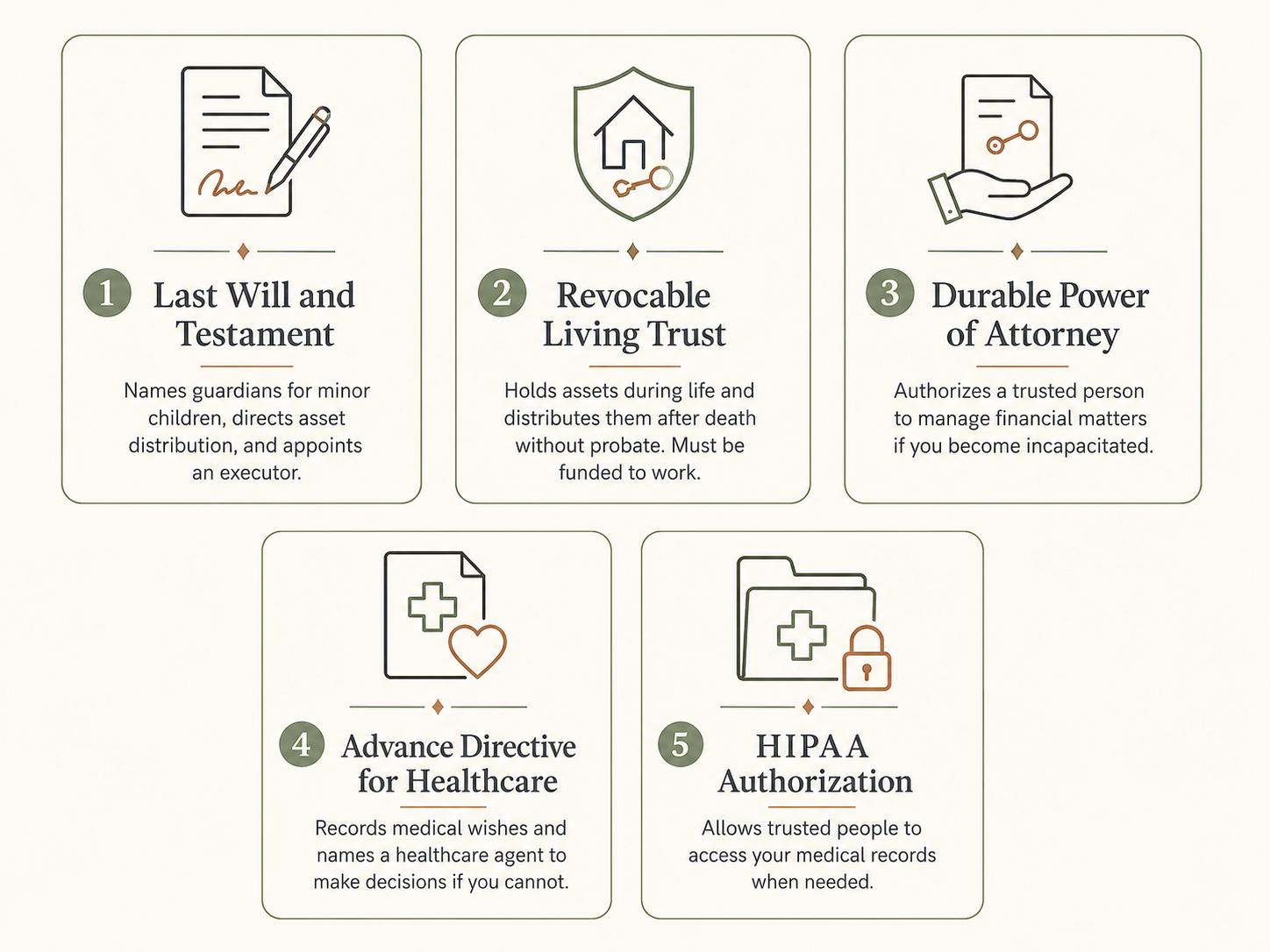
A Last Will and Testament names guardians for minor children, directs how assets should be distributed, and appoints an executor to manage the estate. Georgia law requires a will to be in writing, signed by the testator, and attested by two competent witnesses. Oral wills are valid in Georgia only under extremely narrow circumstances, such as a person in imminent peril of death, and even then, the requirements are stringent. Handwritten wills without witnesses, known as holographic wills, are not recognized in Georgia.
A Revocable Living Trust holds assets during your lifetime and distributes them after death without probate. Creating the trust document is only the first step. You must also fund the trust by retitling assets into its name: real estate deeds, bank accounts, investment accounts, and business interests. An unfunded trust is an empty shell that provides no probate avoidance.
A Durable Power of Attorney for financial matters authorizes someone you trust to manage your finances if you become incapacitated. Georgia law provides statutory forms, but a well-drafted power of attorney can include additional powers tailored to your situation, such as authority to manage business interests, handle tax matters, or make gifts for Medicaid planning purposes.
An Advance Directive for Healthcare combines a living will and a healthcare power of attorney into a single Georgia statutory document. It records your wishes about life-sustaining treatment and designates a healthcare agent to make medical decisions when you cannot. Without this document, your family may face difficult choices without knowing your preferences, and disagreements among relatives can escalate into court battles.
A HIPAA Authorization ensures that the people you name as healthcare agents and financial agents can access your medical records. Without it, privacy regulations may prevent doctors and hospitals from sharing information with the very people you have empowered to make decisions for you.
Will vs. Trust in Georgia: Which Is Right for You?
The choice between a will and a trust is not always either-or. Many Georgia estate plans use both, with a pour-over will that catches any assets inadvertently left outside the trust and funnels them into it. But understanding the differences helps you decide where to focus your resources.
A will is simpler and less expensive upfront. For a young adult with a modest estate, no children from prior relationships, and no out-of-state property, a well-drafted will combined with proper beneficiary designations may be entirely sufficient. Attorney-drafted wills in Georgia typically cost between $500 and $1,500, depending on complexity and the attorney's experience.
A trust costs more initially, often between $2,000 and $5,000 for a comprehensive trust-based plan, but it provides benefits that a will alone cannot. Trusts avoid probate, maintain privacy, and allow for more nuanced control over distributions. A trust can hold assets for a beneficiary's benefit over time rather than distributing a lump sum at age 18, which is what happens with a will absent specific trust provisions. Trusts also handle blended family dynamics more effectively, ensuring that a surviving spouse is provided for during their lifetime while preserving assets for children from a prior marriage.
Many Georgia law firms now offer flat-fee pricing for trust-based estate plans, with some guaranteeing completion within 45 days. This fixed-price model removes the uncertainty of hourly billing and makes the cost of a comprehensive plan predictable from the start.
What Does Estate Planning Cost in Georgia?
The price of estate planning in Georgia spans a wide range, and understanding what you are paying for matters.
Do-it-yourself options, including online will templates and software, cost between $50 and $200. These tools can work for someone with no children, no real estate, and a simple family structure. But they carry real risks. Georgia has specific execution requirements for wills and specific statutory language for powers of attorney. A template that works in California may not comply with Georgia law, and no software can advise you on whether a trust makes more sense than a will for your particular circumstances.
Attorney-assisted basic will packages in Georgia generally run from $1,000 to $1,500. This typically includes a will, a financial power of attorney, and an advance directive for healthcare. For many young families, this package provides adequate protection at a reasonable cost.
Comprehensive estate plans that include a revocable living trust, pour-over will, powers of attorney, and healthcare directives range from $3,000 to $7,000. The price varies by region, with Atlanta metro firms often charging more than firms in smaller cities. Some Georgia firms now offer fixed, upfront pricing with no hourly billing, a growing trend that removes the anxiety of watching the clock run during consultations.
The cost of not planning deserves equal attention. Probate court filing fees, executor commissions, attorney fees, and the time value of assets frozen during administration can consume a significant percentage of an estate's value. For a $500,000 estate, probate costs can easily reach $15,000 to $25,000. Beyond the financial cost, the emotional toll of family conflict, uncertainty, and delay is impossible to quantify.
Special Situations in Georgia Estate Planning
Blended Families and Second Marriages
Georgia's intestacy laws were not written with blended families in mind. If you die without a will, your spouse inherits a share of your estate, and your children inherit the rest. But stepchildren receive nothing unless you legally adopted them. A trust can structure distributions so that a surviving spouse receives income or use of assets during their lifetime, with the remaining principal passing to your children after the spouse's death. This approach prevents the scenario where a surviving spouse remarries and redirects assets away from your children. For a deeper look at these dynamics, the article on estate planning for blended families in Georgia covers the specific strategies that protect both spouses and children from prior relationships.
Business Succession and LLC Ownership
Georgia business owners face a unique challenge: what happens to the company when an owner dies or becomes incapacitated? Without a succession plan, a business interest passes through probate like any other asset, which can freeze operations, create ownership disputes, and force a sale at an inopportune time. Buy-sell agreements funded by life insurance provide a mechanism for surviving owners to purchase the deceased owner's interest, keeping the business intact and providing liquidity to the family. Key person insurance and succession planning should be reviewed alongside personal estate documents to ensure consistency.
Digital Assets and Cryptocurrency
Georgia adopted the Revised Uniform Fiduciary Access to Digital Assets Act, which allows executors and agents to access certain digital accounts, but only if the estate plan explicitly grants that authority. Without it, your family may be locked out of email accounts, social media profiles, online banking, and cryptocurrency wallets. A digital asset inventory that lists accounts, passwords, and access instructions should accompany every estate plan. Cryptocurrency held in self-custody wallets presents a particular challenge. If no one knows your private keys or seed phrase, those assets are effectively destroyed upon your death, with no recovery possible.
Special Needs Planning
If you have a child with disabilities who receives or may receive government benefits such as Medicaid or Supplemental Security Income, a direct inheritance can disqualify them from those programs. A special needs trust allows you to provide for your child's supplemental needs, things like therapy, education, travel, and quality-of-life expenses, without jeopardizing their eligibility for essential benefits. Georgia law firms that focus on special needs planning understand how to coordinate these trusts with public benefits rules. Families navigating this area may also find value in understanding special needs trusts in Georgia and the specific rules that govern them.
How to Choose an Estate Planning Attorney in Georgia
Selecting the right attorney matters as much as deciding to create a plan in the first place. Look for lawyers who concentrate their practice on estate planning and probate rather than handling wills as a side service to a general practice. Membership in the State Bar of Georgia's Elder Law Section or board certification in estate planning signals a deeper commitment to the field.
Ask about fee structure during your initial consultation. Flat-fee arrangements are increasingly common in Georgia and provide transparency that hourly billing does not. Some firms now guarantee turnaround times, with completion within 45 days of engagement. Confirm that the attorney is familiar with the probate court in your specific county, since local rules and judicial preferences vary across Georgia's 159 counties.
Check the attorney's disciplinary history through the State Bar of Georgia website, and read client reviews with attention to responsiveness and clarity of communication. A free initial consultation is standard, and it gives you an opportunity to assess whether the attorney explains complex concepts in plain language and listens to your specific concerns.
Frequently Asked Questions About Georgia Estate Planning and Probate
What is the order of inheritance in Georgia if someone dies without a will? Georgia Code Title 53 establishes a clear hierarchy. If you have a spouse and children, they share the estate. If you have a spouse but no children, the spouse inherits everything. If you have children but no spouse, the children inherit equally. If a child predeceased you, that child's share passes to their children. Beyond spouse and descendants, the estate passes to parents, then siblings, then more distant relatives.
Do you need a lawyer for estate planning in Georgia? Georgia law does not require an attorney to draft a will or trust. However, anyone with minor children, blended family dynamics, business interests, or property in multiple states should work with an experienced Georgia estate planning attorney. The cost of fixing a defective do-it-yourself plan after death far exceeds the cost of doing it right the first time.
How long does probate take in Georgia? A straightforward, uncontested probate typically takes six to twelve months. Estates with creditor claims, will contests, or complex assets can take eighteen months or longer. The timeline also depends on the caseload and procedures of the specific county probate court.
Can you write your own will in Georgia? You can write your own will, but it must meet Georgia's execution requirements: it must be in writing, signed by you, and attested by two competent witnesses who sign in your presence. Handwritten wills without witnesses are not valid in Georgia.
What happens to digital assets like cryptocurrency when someone dies in Georgia? Without explicit instructions and access credentials in your estate plan, your executor may be unable to locate or access digital assets. Cryptocurrency held in self-custody wallets is particularly vulnerable to permanent loss if private keys are not documented and accessible to a trusted person.
Take the Next Step: Estate Planning for Your Georgia Family
Estate planning is not about your age or your net worth. It is about protecting the people who depend on you from uncertainty, court involvement, and conflict. Every Georgia adult who owns property, has children, or cares about what happens to their loved ones after they are gone needs a plan that reflects their actual life, not the state's default formula.
Start with a single step. Make a list of your assets: real estate, bank accounts, retirement funds, life insurance, business interests, digital accounts. Talk with your spouse or partner about guardianship preferences for your children. Then schedule a consultation with a Georgia estate planning attorney who can translate your wishes into legally enforceable documents tailored to your county's probate court.
The documents you sign in 2026 will determine whether your family faces a smooth transition or a prolonged legal process. Delaying only increases the risk that Georgia probate court, not you, will decide who raises your children and who receives your assets. Contact Conner Law Group for a consultation designed around your stage of life, your family structure, and your specific Georgia county.
