
Estate Planning for Blended Families in Georgia

How to protect your spouse, children, stepchildren, and family relationships with a clear plan
Blended families are common, but estate planning for blended families is rarely simple. A second marriage, children from a prior relationship, stepchildren, jointly owned property, retirement accounts, life insurance, and different family expectations can all create legal and practical complications if there is not a clear plan in place.
For Georgia families, this is especially important because the default legal rules may not match what you actually want. Without a carefully prepared estate plan, a surviving spouse, biological or adopted children, stepchildren, and other family members may be left with confusion, conflict, or unintended results.
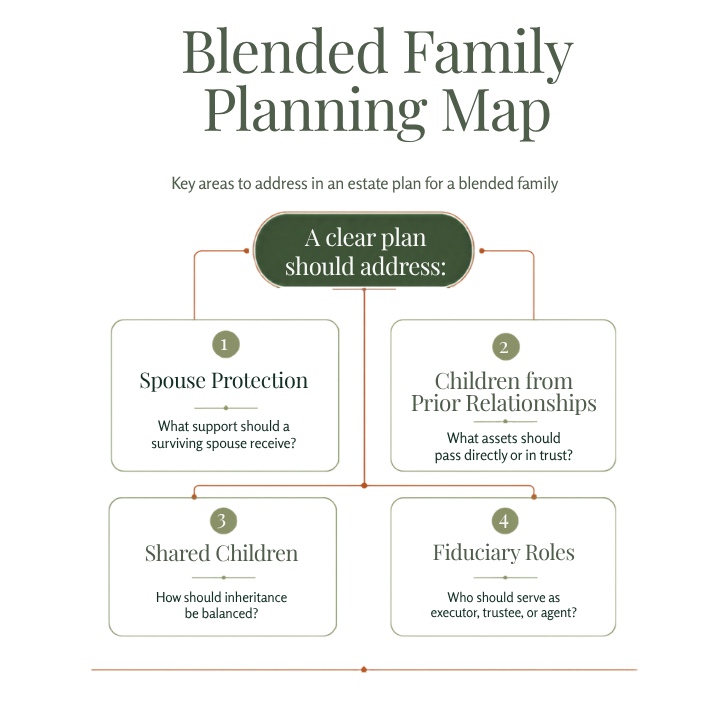
A strong estate plan for a blended family should answer several important questions:
Who should inherit?
When should they inherit?
Who should be in charge?
How should the surviving spouse be provided for?
How should children from a prior relationship be protected?
What happens if there is disagreement after death?
The goal is not just to transfer assets. The goal is to reduce uncertainty, protect the people you love, and minimize the chance of family conflict.

Why Blended Families Need More Than a Basic Will
A simple will may be enough for some families, but blended families often need more detailed planning. The plan should address not only who receives property, but also how competing interests will be balanced.
For example, a person may want to provide for a current spouse while also making sure children from a prior relationship ultimately inherit. That can be difficult if the estate plan simply leaves everything outright to the surviving spouse. Once assets are left outright, the surviving spouse usually controls where those assets go next. The surviving spouse may later change their own estate plan, remarry, spend the assets, or leave property to their own children instead.
On the other hand, leaving everything directly to children from a prior relationship can create hardship for a surviving spouse, especially if the marital home or retirement assets are involved.
A good blended family estate plan should be more precise than “everything to my spouse” or “everything to my children.” It should be structured around the family’s actual relationships, assets, and goals.
What Happens Without an Estate Plan in Georgia?
If someone dies in Georgia without a valid will, Georgia’s intestacy laws determine who inherits probate assets. These rules may not reflect the realities of a blended family.
If a married person dies with a spouse and children, the spouse and children generally share the estate, with the surviving spouse receiving no less than one-third. This can create several issues.
First, the surviving spouse may not receive enough to remain financially secure.
Second, children may inherit directly, even if they are young adults, financially inexperienced, estranged, or receiving government benefits.
Third, stepchildren generally are not treated the same as biological or legally adopted children unless they are specifically included in the estate plan.
Fourth, the family may end up in probate with unclear expectations and competing interests.
The result can be particularly difficult when the family home is involved. A surviving spouse and children from a prior relationship may suddenly become co-owners of property, even if that arrangement is impractical or likely to cause conflict.

Stepchildren and Estate Planning
Many blended families assume that stepchildren will be treated the same as children for inheritance purposes. That is not always the case.
If you want a stepchild to inherit from you, the safest approach is to clearly say so in your estate plan. Do not rely on informal understandings, family assumptions, or general language that could be disputed later.
This is especially important if you refer to “my children” in a will or trust. Depending on the circumstances, that phrase may not clearly include stepchildren. If you want to include or exclude specific people, your documents should be direct.
In many blended family plans, it is helpful to identify beneficiaries by name and relationship. For example, the plan may distinguish between biological children, adopted children, stepchildren, and descendants. Clear drafting can prevent later disputes about intent.
Common Blended Family Estate Planning Concerns
Blended family planning often involves sensitive questions. These issues are not just legal. They are personal, financial, and emotional.
Common concerns include:
How do I provide for my spouse without disinheriting my children?
Should my spouse be allowed to live in the house after my death?
Should the house eventually pass to my children?
What if my spouse and children do not get along?
Should my spouse or one of my children serve as executor?
Should assets be left outright or in trust?
How do I treat children fairly if my spouse has separate assets?
What if one child has special needs, creditor issues, addiction concerns, or financial instability?
What happens to retirement accounts and life insurance?
These questions should be addressed directly. Avoiding them during the planning process often leads to more difficulty later.

Planning for the Family Home
The family home is often the most emotionally charged asset in a blended family estate plan.
A surviving spouse may want or need to remain in the home. Children from a prior relationship may view the home as part of their inheritance. If the home was owned before the marriage, inherited from family, or purchased with separate funds, expectations can become even more complicated.
There are several possible planning approaches. The right option depends on the family and the asset structure.
One option is to leave the home outright to the surviving spouse.
Another option is to leave the home to children, subject to a right for the surviving spouse to live there for a certain period of time or for life.
Another option is to place the home in a trust, with instructions about who may live there, who pays expenses, when the home should be sold, and how proceeds should be distributed.
Another option is to direct that the home be sold and the proceeds divided according to the estate plan.
The key is to make the decision intentionally. If the estate plan is silent or unclear, the surviving family members may be left to resolve the issue during probate.
Trust Planning for Blended Families
Trusts can be especially useful for blended families because they allow more control than an outright gift.
A trust can provide for a surviving spouse during the spouse’s lifetime while preserving remaining assets for children after the surviving spouse’s death. The trust can also specify who serves as trustee, what expenses may be paid, and how disputes should be handled.
For example, a trust may allow the surviving spouse to receive income or distributions for health, maintenance, and support. After the surviving spouse’s death, the remaining trust assets may pass to the deceased spouse’s children.
This structure can be helpful when a person wants to care for a spouse but also ensure that children from a prior relationship are not unintentionally disinherited.
Trusts can also be useful for beneficiaries who should not receive assets outright. This may include minor children, young adult children, beneficiaries with disabilities, beneficiaries receiving SSI or Medicaid, beneficiaries with creditor concerns, or beneficiaries who may need financial oversight.
Choosing the Right Executor or Trustee
In a blended family, the choice of executor or trustee can be just as important as the distribution plan.
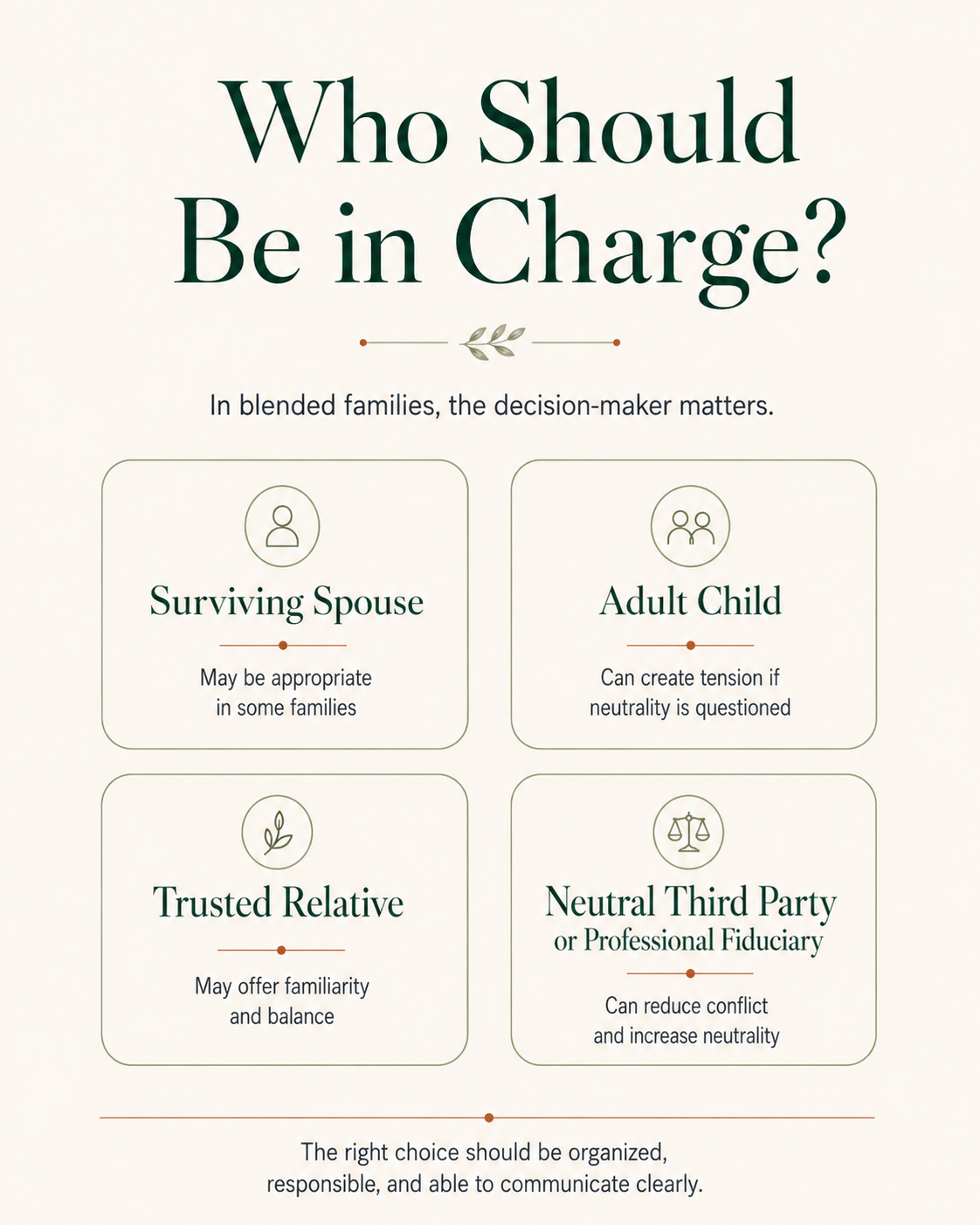
Naming a surviving spouse may make sense in some families. In others, it may create tension with children from a prior relationship. Naming an adult child may also create conflict if the surviving spouse believes that child will not act neutrally.
A neutral third party, professional fiduciary, trusted relative, or co-fiduciary arrangement may be appropriate in some cases. The best choice depends on the family dynamics, the assets involved, and the level of discretion required.
The person in charge should be organized, responsible, and able to follow the terms of the documents. They should also be able to communicate appropriately with beneficiaries and avoid unnecessary conflict.
Beneficiary Designations Matter
A will or trust does not control every asset. Retirement accounts, life insurance, payable-on-death accounts, transfer-on-death accounts, and jointly owned property may pass outside of probate.
That means a blended family estate plan is incomplete unless beneficiary designations are reviewed.
This is a common problem after divorce, remarriage, or the birth of additional children. A person may update a will but forget to update retirement accounts or life insurance. The result may be that a former spouse, one child, or an unintended beneficiary receives a major asset outside the estate plan.
Beneficiary designations should be reviewed as part of the planning process and revisited after major life events.
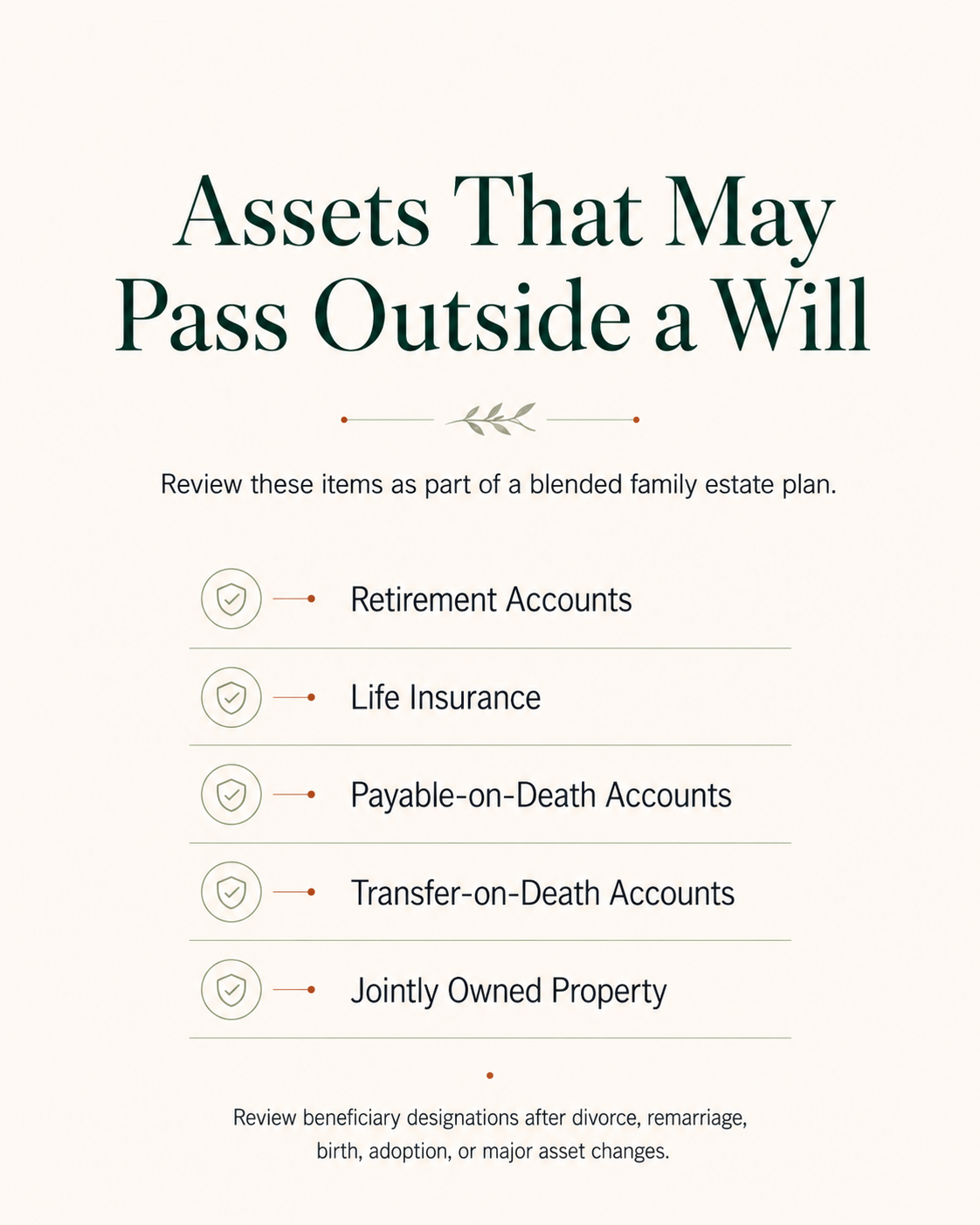
A will or trust may not control every asset. Beneficiary designations should be reviewed as part of a blended family estate plan.
Do Not Rely on Verbal Agreements
Many people in blended families rely on verbal promises.
A spouse may say, “I’ll make sure your children receive what is left.”
Children may say, “We’ll let your spouse stay in the house.”
Family members may say, “We all know what you wanted.”
These statements may be sincere, but they are not a substitute for a legally effective estate plan. Circumstances change. Relationships change. Financial pressure changes. After death, misunderstandings often become disputes.
Clear written documents are far more reliable than informal promises.
Incapacity Planning Is Also Important
Estate planning is not only about what happens after death. It should also address what happens if you become incapacitated. For blended families, incapacity planning can be particularly important because there may be disagreement about who should make medical or financial decisions.
A complete Georgia estate plan should usually include:
A financial power of attorney
An advance directive for health care
HIPAA authorization
A will
Trust planning, when appropriate
Updated beneficiary designations
Without incapacity documents, family members may have to seek court involvement to obtain authority. That can be stressful, expensive, and avoidable.
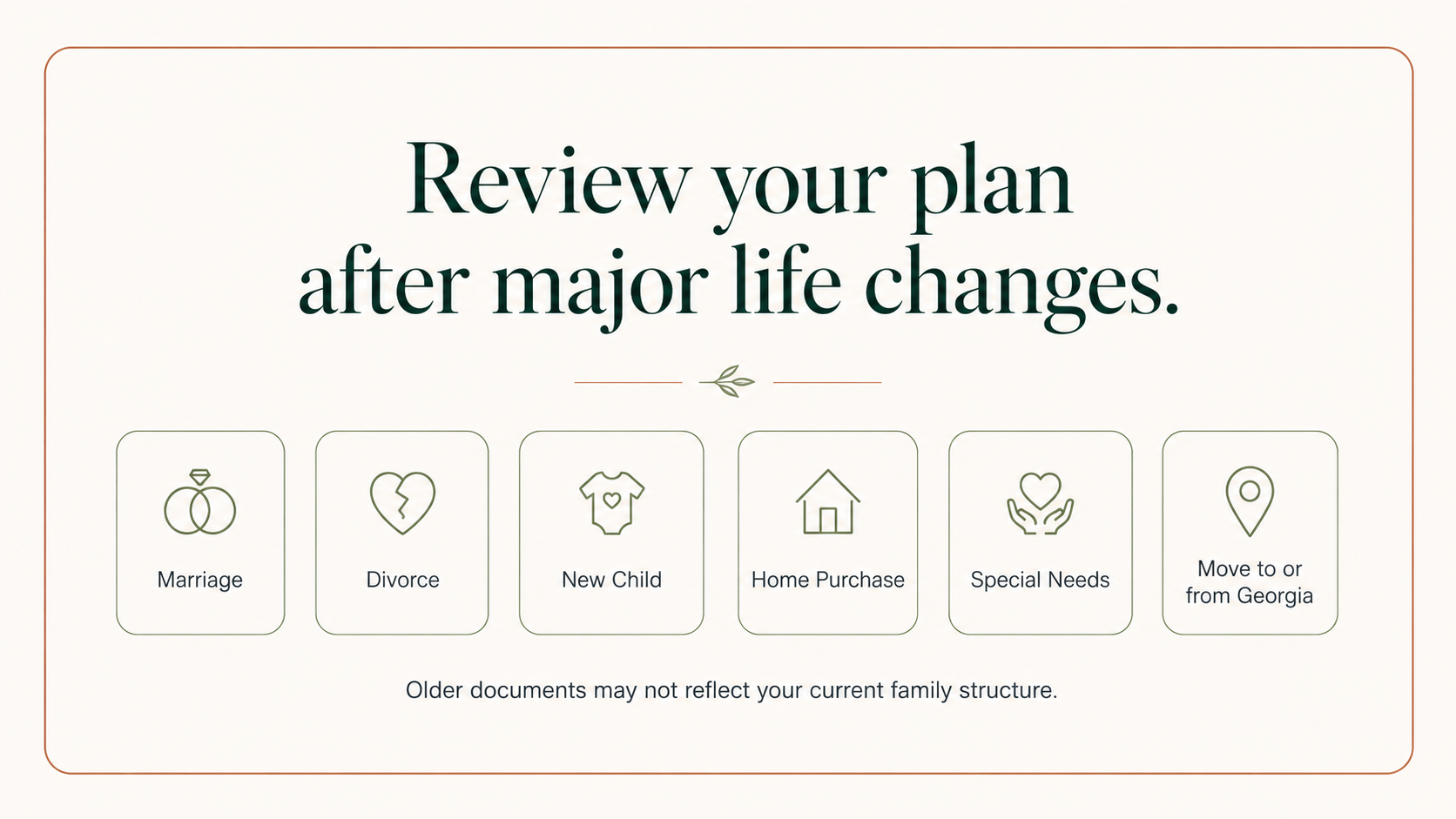
Blended family estate plans should be reviewed after major life events, especially marriage, divorce, new children, and changes in assets.
When to Update an Estate Plan
A blended family estate plan should be reviewed regularly. It should also be updated after major life events, including:
Marriage
Divorce
Birth or adoption of a child
Death of a spouse or beneficiary
A child becoming an adult
Purchase or sale of a home
A significant change in assets
A beneficiary developing special needs or receiving public benefits
A major change in family relationships
Moving to or from Georgia
Even if you already have a will, it may not reflect your current family structure. Older documents can create major problems if they were signed before a remarriage, divorce, or birth of a child.
Practical Steps for Blended Families in Georgia
If you are part of a blended family, start by getting clear on your goals. Decide who you want to benefit, who should be in charge, and whether anyone needs protection through a trust. Review how your assets are titled. Review beneficiary designations. Consider whether your spouse should receive assets outright, in trust, or through a more limited arrangement. Think carefully about the family home and whether your plan could create co-ownership issues. Most importantly, put the plan in writing.
Blended family estate planning is not about choosing one side of the family over another. It is about creating a plan that reflects your wishes and reduces the risk of conflict for the people you leave behind.
Estate Planning for Blended Families in Georgia
Every blended family is different. Some families want to treat all children the same. Others want to preserve separate property for children from a prior relationship while still providing for a spouse. Some families need special needs planning, trust planning, tax planning, or probate avoidance strategies.
The right plan depends on your family, your assets, and your priorities.
Conner Law Group helps Georgia families create estate plans designed for real-life family structures, including second marriages, children from prior relationships, stepchildren, special needs beneficiaries, and complex family dynamics.
If you are in a blended family and are unsure whether your current documents still work, it may be time to review your plan.
