
Georgia STABLE Accounts in 2026: ABLE Accounts and Special Needs Trusts
This article was updated in September 2026. Contribution limits, program fees, tax rules, and public-benefit rules can change.

A Georgia STABLE account can give an eligible individual more flexibility to save and pay qualified disability expenses while preserving important public benefits.
A parent wants to leave money to an adult child who receives SSI and Medicaid. A grandparent wants to help with expenses without unintentionally disrupting benefits. An adult with a disability wants more control over everyday spending without having to keep an ordinary bank account below SSI's resource limit.
A Georgia STABLE account can help with each of these situations.
And beginning in 2026, these accounts became available to significantly more people.
Effective January 1, 2026, an individual may qualify for an ABLE account if the individual's disability or blindness began before age 46, rather than before age 26 under the prior rule.
For eligible Georgians, a STABLE account can provide tax-advantaged savings, greater financial independence, and favorable treatment under programs such as Supplemental Security Income (SSI) and Medicaid.
But a STABLE account is not necessarily a complete special needs plan.
For many families, the better question is not whether to use a STABLE account or a Special Needs Trust. It is how the two should work together.
Key Takeaway: A Special Needs Trust is often better suited for inheritances, larger assets, and long-term financial management. A STABLE account can provide the beneficiary with greater flexibility for qualified everyday expenses. Used together, they can solve different parts of the same planning problem.
| Rule | 2026 Georgia Stable Account |
|---|---|
| Disability onset requirement | Before age 46 |
| Standard annual contribution limit | $20,000 |
| Additional contributions for qualifying workers | Potentially available under ABLE to Work |
| SSI treatment | First $100,000 generally excluded as a resource |
| Qualified withdrawals | Generally tax-free |
| Can pay houses expenses | Yes, subject to SSI timing rules |
| Can work with a Special Needs Trust | Yes |
| Medicaid recovery after death | Potentially applies |
What Is a Georgia STABLE Account?
A Georgia STABLE account is Georgia's version of an ABLE account.
ABLE stands for Achieving a Better Life Experience. ABLE accounts were created under Section 529A of the Internal Revenue Code to allow eligible individuals with disabilities to save and invest money without automatically losing eligibility for certain means-tested government benefits.
Georgia's program is called Georgia STABLE.
Money in a STABLE account can generally grow tax-free when withdrawals are used for Qualified Disability Expenses.
Unlike a Special Needs Trust, however, the account belongs to the individual with the disability.
That distinction is important.
A STABLE account is primarily a savings and spending tool.
A Special Needs Trust is primarily an estate-planning, asset-protection, and long-term management tool.
For many families, both have a role.

Who Qualifies for a Georgia STABLE Account in 2026?
One of the most important changes to ABLE planning took effect January 1, 2026.
Under the previous rules, the individual's disability generally had to begin before age 26.
The age threshold has now increased to age 46.
Importantly, this does not mean the person must open the account before turning 46.
The relevant question is generally when the disability began.
An individual may therefore potentially qualify for a STABLE account at age 50, 60, or older if the qualifying disability or blindness began before age 46 and the other eligibility requirements are satisfied.
The expansion makes ABLE accounts available to many individuals who previously could not qualify.
How Much Can Be Contributed to a Georgia STABLE Account?
For 2026, the standard annual ABLE contribution limit is $20,000.
Contributions can come from multiple sources, including:
The beneficiary;
Parents;
Grandparents;
Other relatives;
Friends; and
In appropriate circumstances, a trust.
The $20,000 limit generally applies to the total standard contributions to the account during the year, not separately to each person contributing.
For example, if parents contribute $10,000 and grandparents contribute another $10,000, the account has generally reached its standard $20,000 annual contribution limit.
What Is ABLE to Work?
Some employed beneficiaries may qualify to contribute additional earned income under the ABLE to Work rules.
That additional contribution is subject to separate requirements and limitations.
This can be particularly valuable for an adult with a disability who is working and wants to build savings while retaining the favorable treatment associated with an ABLE account.
Families should coordinate contributions carefully when several people are contributing to the same account.
How Does a STABLE Account Affect SSI?
This is one of the primary reasons families consider ABLE accounts.
SSI normally imposes a very low resource limit.
For an individual beneficiary, that limit is generally $2,000.
Money held in an ordinary checking or savings account can therefore create significant problems for someone receiving SSI.
ABLE accounts receive different treatment.
The $100,000 SSI Rule
For SSI purposes, the first $100,000 in a qualifying ABLE account is generally excluded from the beneficiary's countable resources.
If the ABLE account exceeds $100,000 and the excess causes the beneficiary to exceed the SSI resource limit, SSI cash payments may be suspended.
Special rules can allow Medicaid eligibility to continue when the excess ABLE balance itself causes the SSI resource problem.
This means a STABLE account can allow a beneficiary to accumulate substantially more than the ordinary $2,000 SSI resource limit.
Does a STABLE Account Affect Medicaid?
Funds properly held in a qualifying ABLE account generally receive favorable treatment for Medicaid eligibility purposes as well.
That can make the account particularly useful for individuals who rely on Medicaid for healthcare, home and community-based services, or other disability-related supports.
However, there is another Medicaid issue families should understand:
What happens to the STABLE account after the beneficiary dies?
That issue is discussed below and is an important reason STABLE accounts and Special Needs Trusts should not automatically be treated as interchangeable.
What Can a Georgia STABLE Account Pay For?
Money from a STABLE account can be used for Qualified Disability Expenses, often abbreviated as QDEs.
The definition is intentionally broad.
Qualified expenses can include expenses related to the beneficiary's disability that help maintain or improve the person's health, independence, or quality of life.
Examples may include:
Housing;
Rent;
Utilities;
Education;
Transportation;
Healthcare expenses;
Prevention and wellness;
Employment training and support;
Assistive technology;
Personal support services;
Financial management;
Legal expenses;
Account administration;
Funeral and burial expenses; and
Certain other basic living expenses.
This flexibility is one of the major advantages of an ABLE account.
It can give the beneficiary more direct control over everyday spending than would typically be available through a Special Needs Trust.
For years, some adults with disabilities were told they could not qualify for an ABLE account because their disability began after age 25. That changed on January 1, 2026.
Under the ABLE Age Adjustment Act, an individual may now qualify if the disability or blindness began before age 46. The individual does not have to be younger than 46 when the account is opened. The relevant question is when the disability began.
For eligible Georgians, a Georgia STABLE account can provide a flexible way to save, invest, and pay disability-related expenses without having the entire account treated as a countable resource for programs such as Supplemental Security Income (SSI) and Medicaid. It can be a powerful tool, but it is not a complete substitute for special needs planning.
Georgia STABLE Account vs. Special Needs Trust
Families sometimes ask whether they should establish a STABLE account or a Special Needs Trust.
That is often the wrong question.
The two tools serve different purposes.
A simple way to think about the distinction is:
Special Needs Trust = Long-Term Protection and Management
STABLE Account = Flexibility and Everyday Spending
Why Would Someone Need a Special Needs Trust if They Have a STABLE Account?
Because an ABLE account has limitations.
Consider a parent who wants to leave $300,000 to an adult child receiving SSI and Medicaid.
The parent cannot simply deposit the entire $300,000 inheritance into the child's STABLE account because annual contribution limits apply.
Leaving the $300,000 directly to the child may also jeopardize eligibility for means-tested public benefits.
A properly structured third-party Special Needs Trust can provide a better solution.
Example: Leaving $300,000 to a Child Receiving SSI
Without Special Needs Planning
Parent dies
↓
Child inherits $300,000 directly
↓
Child now owns substantial countable assets
↓
SSI and Medicaid eligibility may be affected
Using Only a STABLE Account
Parent dies
↓
Parent wants $300,000 to benefit child
↓
Entire inheritance generally cannot simply be contributed to STABLE because annual contribution limits apply
Using a Coordinated Plan
Parent's estate or revocable trust
↓
Third-Party Special Needs Trust
↓
Trustee manages the $300,000 inheritance
↓
Trustee makes appropriate distributions and may fund the beneficiary's STABLE account
↓
Beneficiary uses STABLE funds for qualified everyday expenses
The Special Needs Trust protects and manages the larger pool of assets.
The STABLE account provides flexibility at the beneficiary level.
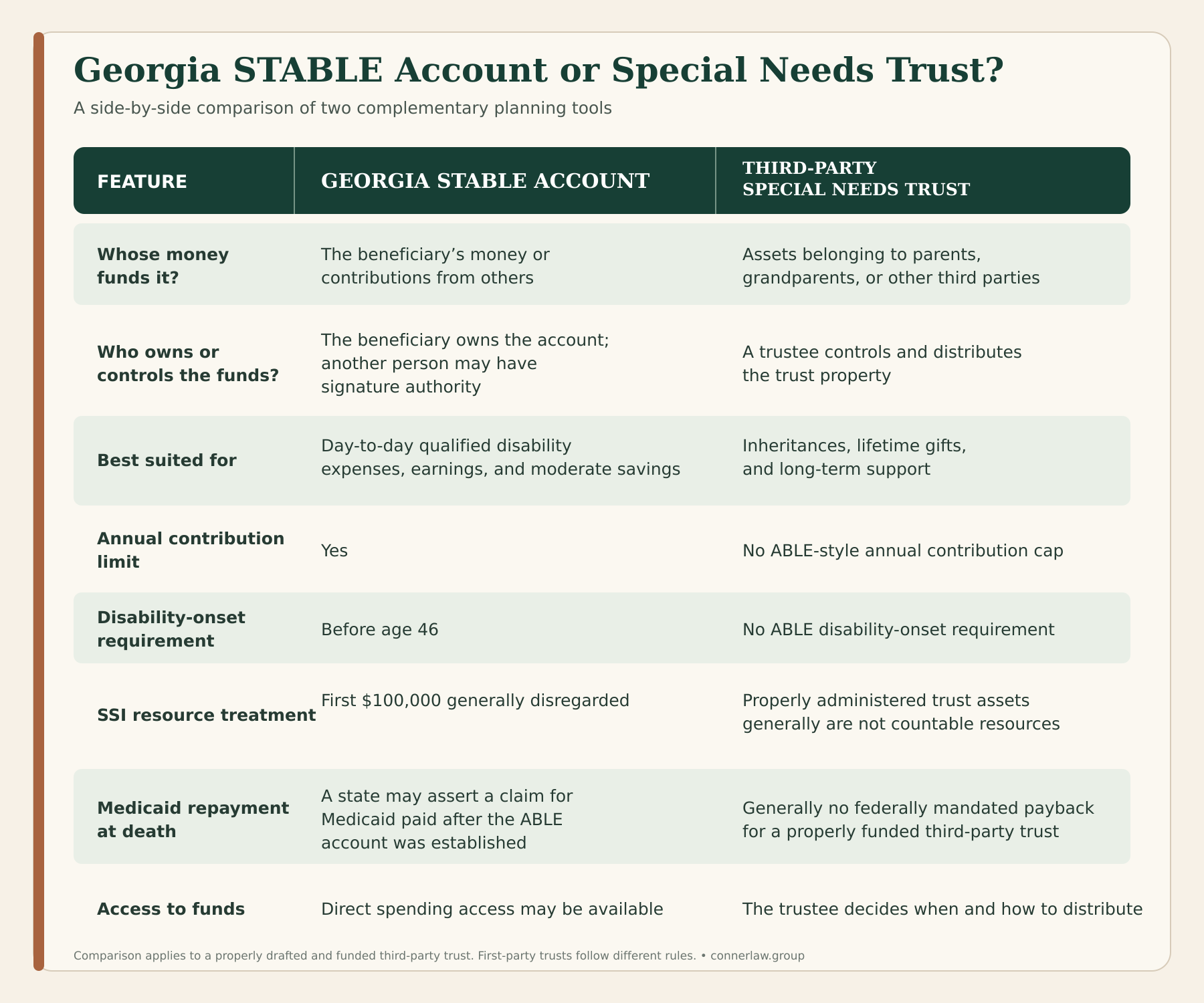
For many families, the better question is not “Which one?”,
but “How should the two work together?”
How Can a Special Needs Trust and a STABLE Account Work Together?
This is where coordinated planning can become particularly useful.
A beneficiary may have both:
A Special Needs Trust; and
A STABLE account.
The trust can hold larger assets and provide long-term financial management.
The trustee can then determine when it is appropriate to pay an expense directly and when it may make sense to contribute funds to the beneficiary's STABLE account.
For example, the trust might own or manage:
Inherited investment accounts;
Life insurance proceeds;
Cash;
Real estate; and
Other family assets.
The STABLE account might then be used for:
Transportation;
Technology;
Education;
Personal support;
Healthcare;
Housing; and
Other Qualified Disability Expenses.
This arrangement can give the beneficiary greater day-to-day independence while preserving long-term financial oversight through the trust.
Can a Special Needs Trust Put Money Into a STABLE Account?
Potentially, yes.
A properly drafted and administered Special Needs Trust may be able to contribute money to a beneficiary's ABLE account.
This can be one of the most useful ways to coordinate the two planning tools.
The trustee must still consider:
The annual ABLE contribution limit;
Contributions already made by other people;
The beneficiary's public benefits;
The terms of the trust;
The proposed expense; and
Whether the transfer is in the beneficiary's best interests.
The ability to move appropriate amounts from a Special Needs Trust into a STABLE account can give the beneficiary access to funds without requiring the trustee to directly manage every relatively small expense.
Why Are STABLE Accounts Particularly Useful for Housing?
Housing is one of the areas where ABLE accounts can be especially useful.
A Special Needs Trust can pay housing expenses, but trust payments for shelter may affect the beneficiary's SSI payment depending on the circumstances and the applicable SSI rules.
ABLE accounts provide another option.
Qualified housing expenses can generally be paid from an ABLE account.
However, timing matters.
A housing distribution taken from an ABLE account and retained into the following month may become a countable resource for SSI purposes.
For example, if a beneficiary withdraws STABLE funds to pay October rent, the funds generally should not simply remain sitting in the beneficiary's checking account after the month ends.
This is an area where individualized benefits planning is important.
The right question is not simply:
"Can the trust pay the rent?"
The better question is:
"What is the most effective way to pay this expense while considering the beneficiary's SSI, Medicaid, independence, taxes, and long-term plan?"
Can Grandparents Contribute to a Georgia STABLE Account?
Yes.
Grandparents can generally contribute to an eligible beneficiary's STABLE account.
However, contributions from grandparents count toward the account's combined annual contribution limit.
For smaller gifts, a STABLE contribution can be an efficient way for grandparents to help.
For larger gifts or inheritances, it may not be the best solution.
For example, a grandparent planning to leave $100,000 to a grandchild with a disability generally should not assume the money can simply be directed into the grandchild's STABLE account.
A third-party Special Needs Trust may provide significantly more flexibility for a substantial inheritance.
This is why parents and grandparents should coordinate their estate planning rather than making beneficiary designations independently.
Should Parents Name a STABLE Account as the Beneficiary of Life Insurance?
Not automatically.
Consider a $500,000 life insurance policy intended to provide for a child with a disability.
Because ABLE accounts have annual contribution limits, simply trying to direct a large insurance benefit into the beneficiary's STABLE account may not accomplish the family's objectives.
A properly drafted third-party Special Needs Trust may be a better beneficiary.
The insurance proceeds can then be managed by the trustee for the beneficiary's lifetime, while the trustee can make appropriate STABLE account contributions when useful.
Similar planning issues can arise with:
Retirement accounts;
Payable-on-death accounts;
Transfer-on-death accounts;
Brokerage accounts; and
Beneficiary designations in a parent's estate plan.
Beneficiary designations should therefore be reviewed as part of the overall special needs plan.
First-Party and Third-Party Special Needs Trusts Are Different
Not every Special Needs Trust operates the same way.
This distinction matters when comparing trusts with STABLE accounts.
Third-Party Special Needs Trust
A third-party Special Needs Trust contains money that belonged to someone other than the beneficiary.
Parents and grandparents frequently use these trusts to provide for a family member with a disability.
For example, parents might establish a third-party Special Needs Trust and direct their estate or life insurance into the trust after they die.
A properly structured third-party Special Needs Trust generally allows the person establishing the plan to decide where remaining assets pass after the beneficiary's death.
For example, remaining funds might pass to:
Siblings;
Nieces or nephews;
Other family members; or
Charity.
First-Party Special Needs Trust
A first-party Special Needs Trust contains assets that already belong to the individual with the disability.
Examples can include:
A personal injury settlement;
An inheritance accidentally left directly to the beneficiary;
Settlement proceeds; or
Other assets already owned by the beneficiary.
First-party Special Needs Trusts must comply with specific federal requirements and generally contain Medicaid reimbursement provisions.
The distinction between first-party and third-party planning becomes especially important when considering what happens to remaining funds after the beneficiary dies.
What Happens to a Georgia STABLE Account When the Beneficiary Dies?
Families should understand this rule before deciding how much money to place in an ABLE account.
Federal ABLE law permits a state Medicaid program, under applicable rules, to seek reimbursement from certain funds remaining in the account after the beneficiary's death for Medicaid assistance provided after the ABLE account was established.
This is commonly referred to as Medicaid payback or Medicaid recovery.
Applicable expenses, deductions, and state rules must also be considered.
This is one reason parents and grandparents should think carefully before directing substantial inheritances toward an ABLE account when a properly structured third-party Special Needs Trust is available.
With a third-party Special Needs Trust, the person creating the trust can generally designate who receives the remaining trust assets after the beneficiary's death.
For example:
Third-Party Special Needs Trust
Parent's assets
↓
Trust benefits child during child's lifetime
↓
Child dies
↓
Remaining assets pass to siblings or other beneficiaries selected by parent
That can be a major distinction when deciding how family wealth should be structured.
Should Parents Leave an Inheritance Directly to a Child's STABLE Account?
For a substantial inheritance, usually the better planning question is whether the inheritance should first pass through a Special Needs Trust.
Because annual contribution limits apply, a STABLE account is generally not designed to receive a large inheritance all at once.
A common planning structure looks like this:
Parent's Estate or Revocable Trust
↓
Third-Party Special Needs Trust
↓
Trustee manages long-term assets
↓
Trustee makes appropriate STABLE contributions
↓
Beneficiary uses STABLE funds for Qualified Disability Expenses
This provides considerably more flexibility than attempting to use the STABLE account as the family's primary inheritance-planning vehicle.
Common Georgia STABLE Account Planning Mistakes
Several seemingly simple decisions can undermine an otherwise thoughtful special needs plan.
Common mistakes include:
Leaving an inheritance directly to a beneficiary who receives means-tested benefits;
Naming the beneficiary individually on a life insurance policy;
Assuming a STABLE account eliminates the need for a Special Needs Trust;
Assuming a Special Needs Trust eliminates the usefulness of a STABLE account;
Exceeding the annual ABLE contribution limit;
Failing to coordinate contributions among parents, grandparents, and other family members;
Failing to monitor SSI rules when using STABLE funds for housing;
Using STABLE funds for nonqualified expenses without considering the consequences;
Creating a Special Needs Trust but failing to update beneficiary designations; and
Failing to consider what happens to remaining assets when the beneficiary dies.
How Do You Open a Georgia STABLE Account?
Eligible individuals can open an account through the Georgia STABLE program.
The enrollment process generally involves:
Confirming eligibility;
Providing identifying information;
Designating an Authorized Legal Representative if appropriate;
Selecting savings or investment options;
Funding the account; and
Establishing procedures for withdrawals and recordkeeping.
Families should retain records showing that withdrawals were used for Qualified Disability Expenses.
The Georgia STABLE program's current enrollment materials, investment options, fees, and administrative rules should be reviewed before opening an account.
Frequently Asked Questions About Georgia STABLE Accounts
-
Yes. Georgia STABLE is Georgia’s ABLE program.
-
No.
Beginning in 2026, the key requirement is generally that the qualifying disability or blindness began before age 46.
A person may potentially open an account later in life if the disability-onset requirement and other eligibility rules are satisfied.Description text goes here
-
Yes.
In fact, using both can be an effective planning strategy because the two tools serve different purposes.
-
Usually not.
A STABLE account can be excellent for everyday spending, qualified expenses, and beneficiary independence.
A Special Needs Trust is usually better suited for substantial inheritances, long-term investment management, real estate, life insurance proceeds, and successor management.
-
Annual contribution limits make a STABLE account impractical as the sole destination for many substantial inheritances.
A third-party Special Needs Trust may provide greater flexibility.
-
Potentially, yes, if permitted by the trust and applicable rules.
The trustee should consider annual contribution limits and the beneficiary's individual circumstances.
-
Yes, qualifying housing expenses can generally be paid from an ABLE account.
However, SSI timing and resource rules must be considered.
-
The first $100,000 in a qualifying ABLE account is generally excluded from SSI resource calculations.
Additional rules apply when the account exceeds that amount.
-
Remaining ABLE funds may be subject to Medicaid recovery under applicable rules.
This is an important distinction between an ABLE account and a properly funded third-party Special Needs Trust.
Sources and Important Notes
This article provides general educational information and is not legal, tax, investment, or benefits advice. Eligibility and the effect of a contribution or distribution depend on individual facts and the rules in effect at the time.
