
Updated October 21, 2026
A home purchased decades ago may be worth several times its original price. Selling it during the owner’s lifetime could trigger capital gains taxes. Leaving the same property to family at death may produce a very different result.
The difference often comes down to stepped-up basis, a tax rule that can reduce the gain heirs recognize when they sell qualifying inherited property.
For Georgia families, understanding this rule before selling a home, changing a deed, or making a lifetime gift can help preserve more of an inheritance.
What Is Stepped-Up Basis?
Stepped-up basis generally adjusts the tax basis of qualifying inherited property to its fair market value at the owner’s death.
Basis is the starting figure used to calculate gain when an asset is sold. It often begins with the purchase price, adjusted for improvements, depreciation, and other applicable items.
When appreciated property qualifies for a basis adjustment at death, the deceased owner’s lifetime appreciation generally falls out of the beneficiary’s later gain calculation. An alternate valuation may apply when properly elected by an estate.
The adjustment can also be downward if the property has declined in value. IRS guidance on inherited property
Selling Before Death Versus Inheriting and Then Selling
Consider a parent who owns a home with:
Adjusted tax basis: $100,000.
Current market value: $400,000.
Here is how the timing of a completed sale could affect the family’s taxes.
Scenario One: The Parent Sells Immediately Before Death
If the parent completes the sale for $400,000 while living, the starting calculation is:
$400,000 sale price − $100,000 adjusted basis = $300,000 gain
That is the gain before selling costs, exclusions, and other adjustments.
The parent’s later death does not erase the gain from an already completed sale. The parent owned and sold the home during life, so the sale must be evaluated under the tax rules applicable to that transaction. Leaving the remaining cash to children does not retroactively give the sold house a stepped-up basis.
However, a $300,000 gain does not necessarily mean $300,000 is taxable.
If the home qualifies as the parent’s main residence, the federal home-sale exclusion may eliminate some or all of the gain:
A qualifying individual may exclude up to $250,000.
Qualifying married taxpayers filing jointly may exclude up to $500,000.
Eligibility generally depends on ownership and use requirements, prior exclusions, and other rules.
For example, if a single parent qualifies for the full $250,000 exclusion, the simplified $300,000 gain could leave $50,000 of taxable gain, before selling costs and other adjustments. If a qualifying couple can use the full $500,000 exclusion, the entire $300,000 gain could be excluded.
A rental property or second home may not qualify for the same exclusion. Rental history and depreciation can also complicate the calculation. IRS guidance on selling your home
Scenario Two: The Child Inherits the Home and Then Sells
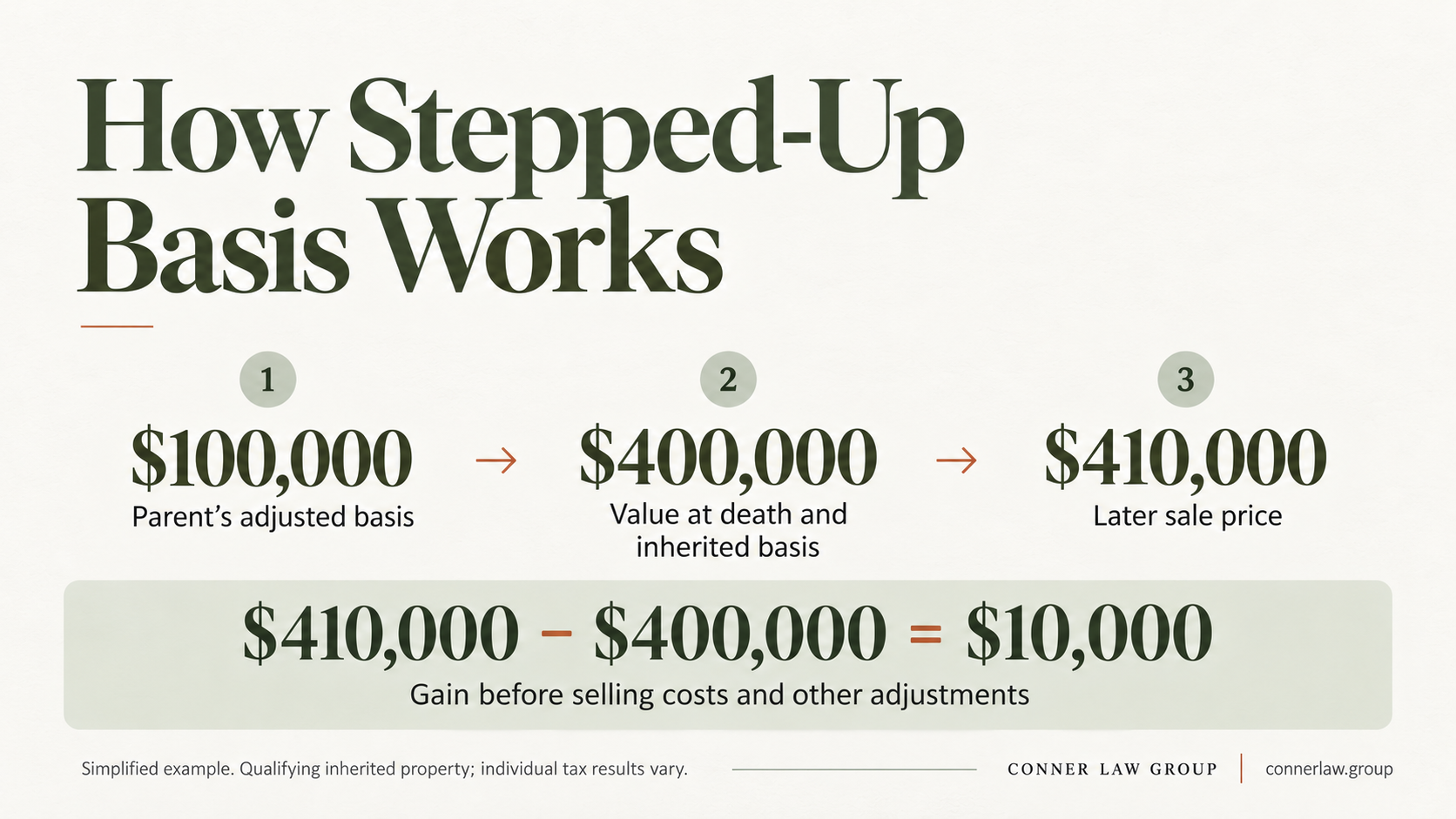
Assume instead that the parent owns the qualifying property at death, when it is worth $400,000. The child’s inherited basis generally becomes $400,000.
If the child then sells for $400,000:
$400,000 sale price − $400,000 inherited basis = $0 gain
If the child later sells for $410,000:
$410,000 sale price − $400,000 inherited basis = $10,000 gain
Both calculations are before selling costs and other adjustments. The child generally does not need to qualify for the parent’s home-sale exclusion to benefit from the inherited basis adjustment. IRS explanation of inherited-property sales
How Much Tax Could the Family Save?
The savings depend on the gain that would otherwise be taxable and the applicable tax rates.
For illustration, if a lifetime sale would leave $50,000 of taxable long-term capital gain, and that gain were taxed at a 15% federal rate, the federal capital gains tax would be $7,500. A qualifying inherited-property basis adjustment could eliminate that pre-death appreciation from a later sale calculation.
This example excludes state taxes, potential net investment income tax, selling costs, and other adjustments. If the lifetime sale already qualifies for a full home-sale exclusion, there may be no federal capital gains tax to save on that sale.
The right comparison is the actual after-tax result—not simply whether a sale occurs before or after death.
Should You Keep the House Until Death?
Retaining appreciated property may preserve a valuable tax benefit, but taxes are only one consideration.
An owner may need sale proceeds for care, housing, debt, or financial security. Maintenance costs, market risk, and family circumstances also matter. A sale that supports the owner’s needs may be the better decision.
Contracts entered into before death, installment sales, and closings that span the date of death require separate analysis. Do not assume that delaying a closing automatically creates a basis adjustment. IRS guidance for survivors and estates
Why Giving the House to Children Can Backfire
An outright lifetime gift generally carries over the parent’s basis for calculating the child’s gain.
In our example, a child receiving the home as a gift could generally begin with the parent’s $100,000 basis. Selling for $400,000 could produce $300,000 of gain before adjustments and any available exclusion.
Adding a child to a deed can also create ownership and tax consequences. It does not automatically preserve a full basis adjustment for the entire property.
Before making a gift, compare potential income taxes, estate taxes, control, creditor exposure, and long-term care needs. IRS Publication 551, Basis of Assets
Other Tax Planning Opportunities for Your Family
Coordinate Retirement Account Withdrawals
Traditional IRAs and similar tax-deferred accounts generally do not receive a basis adjustment that eliminates income taxes on distributions.
Many adult children must empty inherited retirement accounts by the end of the tenth year after the owner’s death. Annual required distributions may also apply. Planning withdrawals across available years can help manage income tax brackets while meeting deadlines.
Surviving spouses and certain other beneficiaries have different options. IRS retirement beneficiary rules
Preserve a Spouse’s Unused Estate Tax Exclusion
For deaths in 2026, the federal basic estate and gift tax exclusion is $15 million per person, before accounting for prior taxable gifts and other applicable adjustments.
A portability election may allow a surviving spouse to use a deceased spouse’s unused exclusion. It generally requires filing Form 706, even when no estate tax would otherwise be due. The benefit is not automatic. IRS Form 706 instructions
Review Trusts Before Transferring Appreciated Assets
A trust can serve important family goals, but not every trust preserves a basis adjustment.
Assets in many revocable living trusts can qualify. Certain irrevocable trust arrangements do not. The IRS has confirmed that grantor-trust status alone does not create a basis adjustment for assets outside the deceased owner’s gross estate under the circumstances addressed in Revenue Ruling 2023-2. IRS ruling
Understand Life Insurance Tax Treatment
Life insurance death benefits paid to a beneficiary are generally excluded from federal gross income. Interest paid on those proceeds is generally taxable.
Estate tax treatment is a separate question and can depend on policy ownership and other circumstances. IRS life insurance guidance
Does Georgia Have an Estate Tax?
Georgia currently does not impose a state estate tax or require a state estate tax return.
Families may still face federal estate taxes, income taxes on retirement distributions, or capital gains taxes when assets are sold. Connections to another state may create additional obligations. Georgia Department of Revenue

Frequently Asked Questions
Do small estates qualify for stepped-up basis?
Yes. Qualifying inherited property can receive a basis adjustment even when no federal estate tax return is required.
Does avoiding probate also avoid taxes?
No. Probate and taxation follow different rules. A trust, beneficiary designation, or deed may change how property transfers without eliminating taxes.
Does stepped-up basis protect a home from Medicaid estate recovery?
No. Tax basis and Medicaid estate recovery are separate issues. A potential basis adjustment does not itself protect property from a recovery claim. Georgia Medicaid estate recovery information
What records should the family keep?
Keep ownership documents, purchase and improvement records, depreciation schedules, investment statements, and reliable date-of-death valuations. A qualified appraisal may be important for real estate and other hard-to-value assets.
Before You Sell, Give Away Property, or Change a Deed
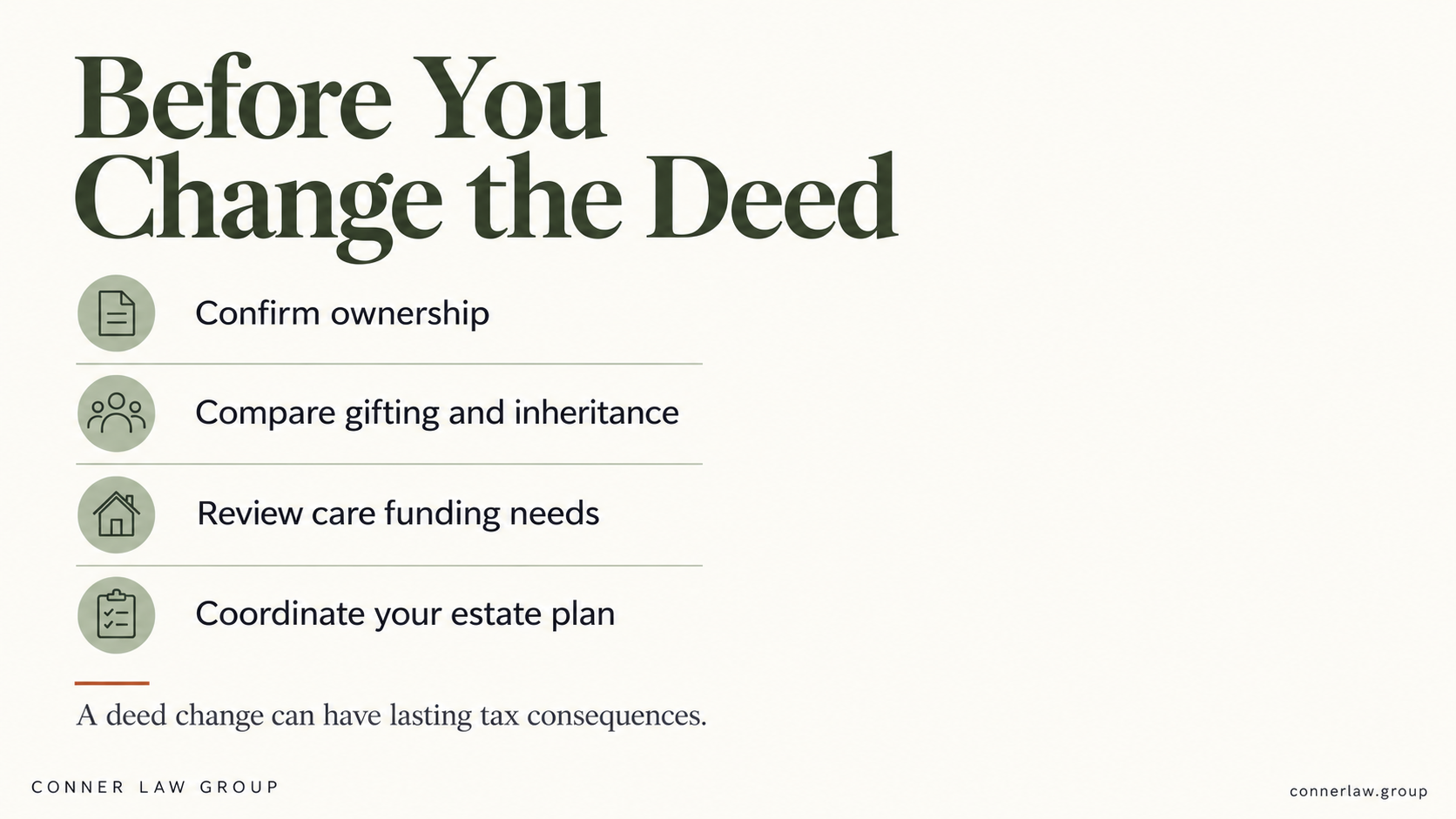
A useful planning review asks:
What is the property’s adjusted basis and current value?
Would a lifetime sale qualify for a home-sale exclusion?
How would a gift or ownership change affect future taxes?
Does the owner need the property or its income for care?
Do the deed, will, trust, and beneficiary designations work together?
These questions can reveal tax-saving opportunities before a transaction becomes difficult to undo.
Make a Plan That Leaves More to Your Family
Conner Law Group helps Georgia families coordinate estate planning and tax planning.
Before selling appreciated property, giving away a home, or changing a deed, understand how the decision could affect both your financial security and your family’s inheritance.
Schedule a consultation with Conner Law Group to discuss your options.
This article provides general information under the rules in effect as of October 21, 2026. Examples are simplified and are not predictions of individual tax results. Legal and tax advice should address your specific circumstances.
