
When most people think about inheriting money, they assume that an inheritance is tax-free. While that is often true for cash and many other assets, inherited retirement accounts are different.
A traditional IRA can carry a substantial income tax obligation for the person who inherits it. Depending on the beneficiary's circumstances, the timing of withdrawals can make a meaningful difference in how much of the inheritance ultimately remains.
For families planning for children, administering an estate, or providing for a loved one with disabilities, these rules deserve particular attention.
1. An Inherited IRA Is Not Necessarily Tax-Free
Generally, distributions from a traditional IRA are included in the recipient's taxable income, except to the extent attributable to basis or another applicable exclusion.
The fact that an account was inherited does not eliminate this potential tax liability.
For example, imagine a parent leaves a $300,000 traditional IRA to an adult child. If the child withdraws the entire account in one year, that distribution could substantially increase the child's taxable income and potentially push some of it into higher federal income tax brackets.
Spreading distributions across several years may reduce the overall tax burden in some circumstances, although investment growth, other income, and applicable withdrawal requirements must also be considered.
This is one reason estate planning should account for what beneficiaries inherit, not simply how much they inherit.
2. The 10-Year Rule Can Create Unexpected Tax Consequences
Under the SECURE Act and subsequent regulations, many nonspouse beneficiaries inheriting IRAs from owners who died after 2019 must fully distribute the inherited account by December 31 of the tenth year following the original owner's death.
That does not always mean the beneficiary can ignore distributions until the tenth year.
If the original IRA owner died on or after their required beginning date for required minimum distributions (RMDs), many beneficiaries subject to the 10-year rule must also take annual required distributions during the applicable period.
If the owner died before the required beginning date, a beneficiary subject to the standard 10-year rule generally does not have annual required distributions before the final year.
The rules differ for certain eligible designated beneficiaries, including surviving spouses, qualifying minor children of the account owner, and individuals who meet applicable disability or chronic illness requirements.
Why the withdrawal schedule matters
Consider someone who inherits a $250,000 IRA while already earning a substantial salary.
Taking a large withdrawal during a high-income year could increase the tax paid on the distribution. Reviewing projected income, retirement plans, and mandatory withdrawal dates may reveal a better distribution strategy.
Importantly, the rules do not guarantee that spreading distributions will always produce the lowest overall tax. Each beneficiary's circumstances need to be evaluated.
3. Retirement Accounts and Probate Follow Different Rules
In Georgia, retirement accounts with valid beneficiary designations generally pass directly to the named beneficiaries rather than through probate.
But avoiding probate does not mean avoiding income tax.
The person designated to receive the account may still have to comply with inherited IRA distribution and income-tax rules.
Problems can arise when beneficiary designations are outdated, a beneficiary has died, or an estate is named instead of an individual.
Naming an estate as beneficiary may result in less favorable distribution rules than those available to a qualifying individual beneficiary.
This is why I encourage families to review retirement-account beneficiaries alongside their wills and trusts.
A carefully drafted will cannot necessarily correct an unfavorable or outdated IRA beneficiary designation.
4. Special Needs Beneficiaries Require Additional Planning
This is an area where tax planning and special needs planning intersect.
Individuals who qualify as disabled or chronically ill under the applicable federal retirement distribution rules may be treated as eligible designated beneficiaries.
That status can permit distributions based on life expectancy rather than the standard 10-year payout requirement, subject to the governing rules.
However, there is an important complication.
A direct inheritance may affect eligibility for means-tested benefits such as Supplemental Security Income (SSI) or certain Medicaid programs.
A properly structured third-party Special Needs Trust can help coordinate an inheritance with benefits protection.
Certain qualifying trusts, including appropriately structured applicable multi-beneficiary trusts, may also preserve favorable retirement-account distribution treatment for beneficiaries with disabilities or chronic illnesses.
These rules are technical. Not every Special Needs Trust qualifies for the same IRA distribution treatment, and favorable retirement distribution rules do not necessarily produce favorable trust income-tax treatment.
The trust language, beneficiary designation, and applicable disability or chronic illness documentation must be coordinated.
For families supporting a loved one with special needs, simply naming the trust on an IRA without reviewing the tax consequences can be an expensive mistake.
Learn more in our article, Special Needs Trusts in Georgia: What Families Need to Know.
5. Inherited IRAs Are Different From Inherited Real Estate
Another common misunderstanding is that all inherited assets receive the same tax treatment.
Qualifying inherited real estate and certain investments may receive a basis adjustment at death, often called a stepped-up basis.
Traditional IRAs generally do not receive a corresponding basis adjustment that eliminates income tax on previously untaxed retirement distributions.
For example:
An inherited home may receive a new tax basis reflecting its fair market value at death.
An inherited traditional IRA generally retains its income-tax characteristics, meaning taxable distributions remain taxable.
The difference matters when deciding how to allocate assets among beneficiaries.
Read our related article, Leave More to Your Family: How Stepped-Up Basis Can Save Taxes.
6. What About an Inherited Roth IRA?
An inherited Roth IRA may offer more favorable income-tax treatment because qualifying distributions are generally tax-free.
However, inherited Roth IRAs remain subject to post-death distribution requirements. Many nonspouse beneficiaries must still empty the account within 10 years.
Additionally, the Roth IRA five-year rule can affect the tax treatment of earnings.
The beneficiary's classification and the account's history both matter.
7. Five Questions to Ask Before Naming an IRA Beneficiary
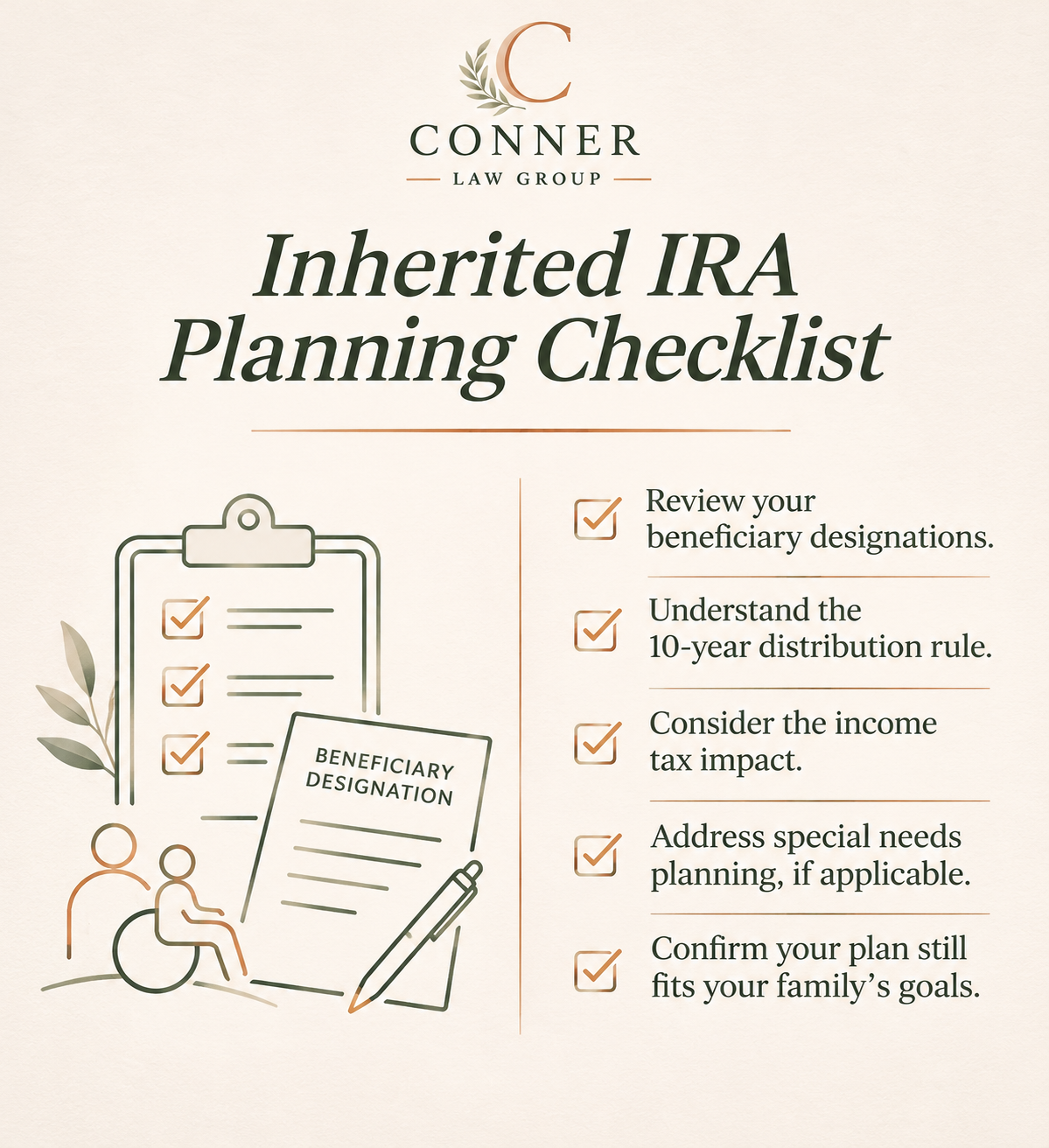
Before finalizing your estate plan or changing a retirement-account beneficiary designation, consider:
Who will inherit the retirement account, and what is their likely income-tax situation?
Are your beneficiaries eligible for any exceptions to the 10-year distribution requirement?
Would an inheritance interfere with a beneficiary's SSI or Medicaid eligibility?
Should a trust receive the IRA, and has that trust been drafted specifically for retirement assets?
Do your IRA beneficiaries match your current estate planning objectives?
These questions are especially important following a marriage, divorce, birth, death, disability diagnosis, or major change in financial circumstances.
Frequently Asked Questions
Does an inherited IRA have to go through probate in Georgia?
Generally, not when a valid beneficiary designation directs the account to a surviving beneficiary. Different rules may apply if the estate becomes the recipient or the designation is ineffective.
Do beneficiaries have to pay income taxes on inherited IRAs?
Traditional IRA distributions are generally taxable to the extent the account contains previously untaxed funds. Roth IRA distributions may qualify for tax-free treatment.
Can a Special Needs Trust inherit an IRA?
Yes, but the trust must be carefully drafted and coordinated with the account's beneficiary designation. Tax and public-benefit consequences require separate consideration.
Is an inherited IRA always subject to the 10-year rule?
No. Certain eligible designated beneficiaries qualify for exceptions, and other factors, including the original owner's date of death and beneficiary classification, affect the applicable rules.
Coordinating Your Estate Plan With Your Tax Plan
Estate planning is not simply about deciding who receives your assets.
It also involves understanding how those assets will transfer, how they will be taxed, and whether they will accomplish the goals you intended.
At Conner Law Group, we combine estate planning, probate, special needs planning, and tax experience to help Georgia families consider the full picture.
Attorney Mandy Conner's background includes experience with the IRS Office of Chief Counsel, providing an additional tax-law perspective when evaluating estate planning decisions.
Whether you are reviewing your own retirement-account beneficiaries or navigating an inherited IRA following a loved one's death, coordinating these issues early can make a substantial difference.
Schedule a Complimentary Consultation With Conner Law Group
This article provides general legal and tax information based on federal rules reviewed in November 2026. Individual outcomes depend on account type, beneficiary status, governing documents, and applicable law. This article does not constitute individualized legal or tax advice.
