
Georgia could see significant Medicaid changes in 2027. Here's what families should know about expanded eligibility, Georgia Pathways, new federal requirements, and long-term care planning.
Georgia's Medicaid program could look very different in 2027.
Following the November 2026 election, Medicaid expansion is once again a major topic in Georgia. Governor-elect Keisha Lance Bottoms has identified expanding healthcare access as a priority, and the incoming General Assembly is expected to revisit proposals that could make hundreds of thousands of additional Georgians eligible for coverage.
But what would Medicaid expansion actually look like? Who would qualify? And would expanded eligibility help families navigating disability benefits, nursing home costs, or long-term care?
The answers depend on which changes Georgia ultimately adopts.
For now, Georgia has not implemented full Medicaid expansion under the Affordable Care Act. Its existing Georgia Pathways to Coverage program offers a more limited option for certain low-income adults.
Here's what Georgia families should understand about the possible changes and why the distinctions matter.
Key Takeaway: Georgia may significantly expand Medicaid eligibility in 2027, but broader health insurance coverage would not automatically change the rules governing nursing home Medicaid, Special Needs Trusts, or Medicaid estate recovery. Understanding which program applies to your family remains essential.
What Is Medicaid Expansion?
Medicaid is a government health insurance program that provides coverage to individuals and families who meet certain eligibility requirements.
Georgia currently provides Medicaid through several categories, including coverage for qualifying children, pregnant women, certain parents, older adults, and people with disabilities.
However, many low-income adults do not qualify for traditional Medicaid.
Under the Affordable Care Act, states can expand Medicaid eligibility to adults ages 19 through 64 with incomes up to approximately 138% of the federal poverty level.
In 2026, that would generally represent annual household income of approximately:
$22,025 for an individual.
$29,863 for a household of two.
$45,540 for a household of four.
These figures reflect the approximate effective income threshold after the applicable income disregard. Actual eligibility depends on household composition, income calculations, and other program requirements.
Full Medicaid expansion could provide coverage for adults who currently earn too much to qualify for existing Medicaid programs but may struggle to afford private health insurance.
Families can review Georgia's existing coverage categories through the Georgia Department of Community Health's Medicaid eligibility information.
What Does Georgia Have Now?
Georgia currently operates a program called Georgia Pathways to Coverage.
Launched in July 2023, Pathways offers Medicaid coverage to certain adults ages 19 through 64 whose household incomes do not exceed 100% of the federal poverty level.
For 2026, that generally means approximately $15,960 annually for an individual.
Pathways has also required participants to demonstrate at least 80 hours per month of qualifying activities, such as employment, education, job training, or community service. Certain other circumstances can also qualify.
The program was designed to increase access to healthcare while encouraging participation in employment and other activities.
However, its actual enrollment has fallen substantially below the number of Georgians potentially eligible.
According to an October 2026 report from the Georgia Budget and Policy Institute, approximately 18,527 people were actively enrolled in Pathways as of June 30, 2026.
The report also identified enrollment and coverage-continuity challenges associated with administrative requirements.
For individuals who do not qualify for Pathways, or who have difficulty meeting and documenting its requirements, the existing program may leave a significant coverage gap.
Why Is Medicaid Expansion Being Discussed Again?
Georgia's November 2026 election has changed the political landscape surrounding Medicaid expansion.
Governor-elect Keisha Lance Bottoms has pledged to pursue broader Medicaid eligibility, and Democrats will control the governor's office and state House beginning in 2027. Republicans will retain a narrow majority in the Georgia Senate.
As explained in November 2026 reporting from The Atlanta Journal-Constitution, the new political alignment creates an opportunity to revisit Medicaid expansion, although legislative approval is not guaranteed.
Supporters of expansion argue that broader eligibility could improve access to preventive healthcare, reduce uncompensated hospital care, and provide additional support for rural hospitals serving uninsured populations.
Opponents have raised concerns about state spending, the reliability of federal funding, healthcare provider capacity, and the long-term costs of maintaining expanded coverage.
The question is not simply whether Georgia will expand Medicaid.
It is how expansion would be structured, financed, and administered.
What Could Medicaid Expansion Look Like in Georgia?
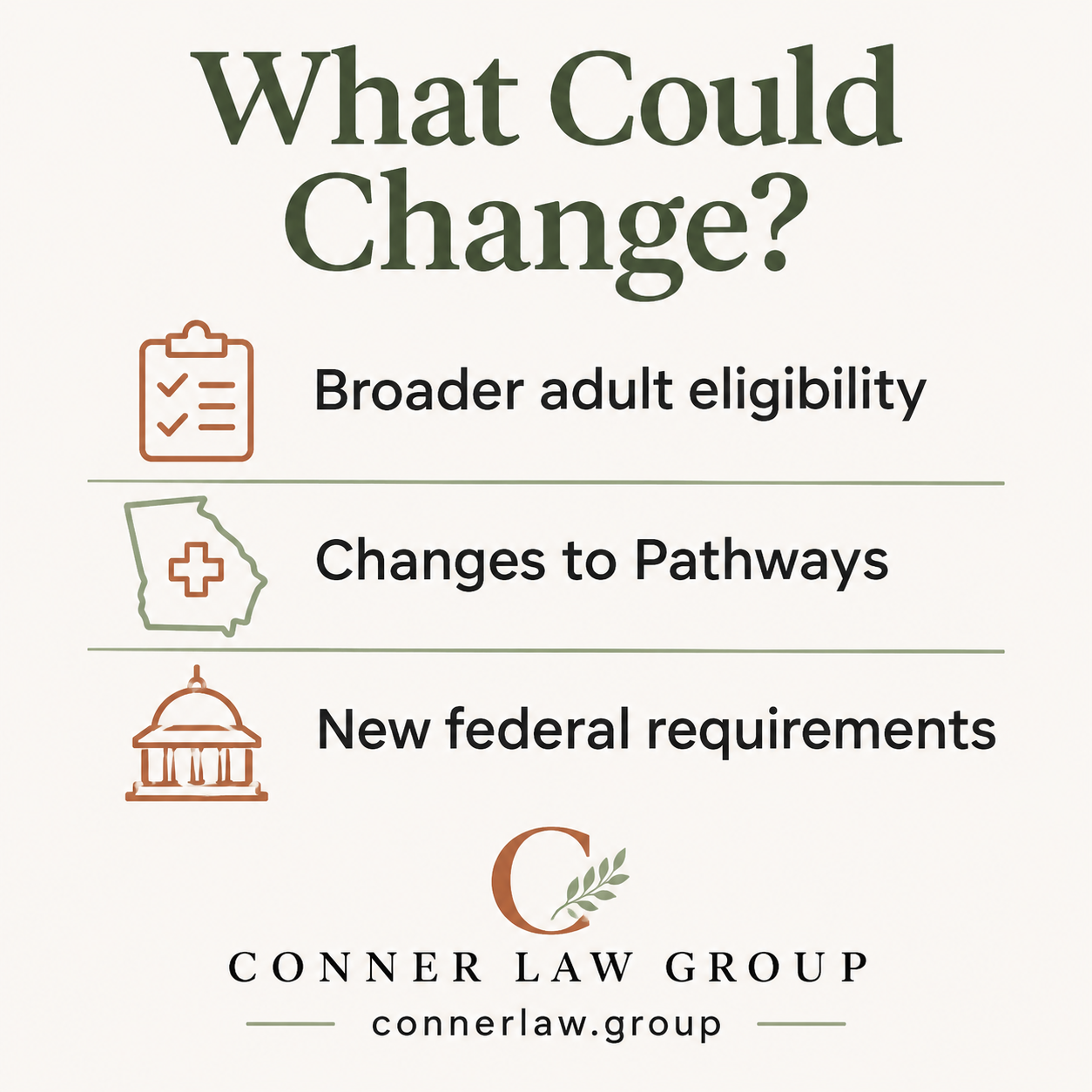
Several approaches are possible.
1. Full Medicaid Expansion
Georgia could adopt traditional Affordable Care Act expansion and extend eligibility to qualifying adults with incomes up to approximately 138% of the federal poverty level.
Under the established federal financing framework, the federal government generally covers 90% of qualifying expansion benefit costs, with states responsible for the remaining 10%.
This approach could substantially increase the number of adults eligible for healthcare coverage.
However, changes in federal law, including new community engagement requirements scheduled for 2027, would still affect how coverage is administered.
2. Medicaid-Funded Private Insurance
Georgia could consider a model that uses Medicaid funding to provide eligible individuals with coverage through private insurance plans.
Similar approaches have previously been discussed in Georgia, including proposals modeled after programs adopted in other states.
Possible advantages include integration with existing insurance networks and additional flexibility in coverage administration.
However, provider networks, benefits, costs, and federal approval requirements would depend on the specific proposal.
3. Modifying or Replacing Georgia Pathways
Another possibility involves changing or replacing Georgia's existing Pathways program.
Georgia has requested additional federal approval concerning Pathways, including enhanced federal funding.
As discussed in the Georgia Budget and Policy Institute's October 2026 analysis, the state requested a 90% federal matching rate for Pathways benefits beginning in January 2027, even though the program's eligibility threshold remains lower than that of full expansion.
The incoming administration has also expressed interest in moving away from Pathways in favor of broader Medicaid expansion.
Whether Pathways continues, changes, or is replaced will depend on legislative and federal decisions.
For Georgians currently enrolled in Pathways, monitoring official updates will be particularly important.
What Medicaid Changes Are Coming in January 2027?
Even if Georgia does not immediately adopt full expansion, federal legislation is scheduled to change Medicaid eligibility procedures in 2027.
According to the state's official guidance on H.R. 1 changes to Georgia Pathways, revised eligibility requirements begin January 1, 2027. Current Pathways beneficiaries generally will not be affected until their renewal in 2027.
The new framework continues to include community engagement requirements for applicable individuals, generally requiring 80 hours per month of qualifying activities or satisfaction of certain earnings criteria.
However, federal law also provides exemptions or exceptions for qualifying individuals.
These may include:
Individuals who are medically frail or have significant qualifying medical needs.
Parents, guardians, and caregivers of dependent children age 13 or younger.
Family caregivers of individuals with disabilities.
Certain veterans with qualifying disabilities.
Individuals participating in qualifying substance use treatment programs.
Individuals experiencing specified temporary hardships.
For families providing substantial care to a loved one, these provisions may be particularly important.
For example, a person caring for an adult child with disabilities may qualify for an exemption from community engagement requirements that would otherwise apply.
However, families should not assume that caregiving automatically establishes an exemption. Eligibility, documentation, and the applicable administrative procedures still matter.
The Centers for Medicare & Medicaid Services' Georgia eligibility guidance provides additional information about these changes.
How Could Medicaid Expansion Affect Families with Disabilities?
This is one of the most important distinctions in the discussion.
Many individuals with disabilities already qualify for Medicaid through disability-related eligibility categories. Others may qualify based on income or particular medical circumstances.
Expanding Medicaid could help some adults obtain healthcare coverage without having to qualify through an existing disability-related pathway.
However, Medicaid health insurance eligibility is not the same as eligibility for long-term disability services.
Georgia's home and community-based waiver programs, including programs for individuals with intellectual and developmental disabilities, have separate financial, functional, and administrative requirements.
Full Medicaid expansion would not automatically eliminate waiver waiting lists or guarantee access to every service.
Likewise, broader Medicaid eligibility would not eliminate the need for careful special needs planning.
An improperly structured inheritance, gift, or beneficiary designation can still affect eligibility for means-tested benefits.
For example, a parent who leaves an inheritance outright to an adult child receiving Supplemental Security Income (SSI) and Medicaid could unintentionally jeopardize those benefits.
A properly structured Special Needs Trust may allow assets to be used for the individual's benefit while helping preserve eligibility for important public benefits.
Our article, Special Needs Trusts in Georgia: What Families Need to Know, explains the different types of trusts and how they can help families provide long-term support.
Families may also want to consider a Georgia STABLE account, which can help eligible individuals save and pay for qualified disability expenses while receiving favorable treatment under certain public-benefit rules.
As we discuss in Special Needs Planning Is More Than a Trust: 7 Pieces of a Coordinated Plan, protecting benefits is only one component of a comprehensive plan.
Financial support, decision-making authority, housing, caregiving arrangements, and the selection of appropriate trustees or other fiduciaries are all important considerations.
What About Seniors and Nursing Home Medicaid?
For families caring for aging parents, Medicaid expansion can sound like welcome news.
But expanding Medicaid coverage for low-income adults does not automatically change the rules for nursing home Medicaid.
Georgia already provides Medicaid coverage for qualifying long-term care services, including nursing home care and certain home and community-based services.
Eligibility for these programs generally involves separate financial and medical requirements.
Depending on the particular program and family circumstances, those considerations may include:
Income and resource limits.
Medical and level-of-care requirements.
Protections for a spouse remaining at home.
Transfers of assets during the applicable look-back period.
Medicaid estate recovery after death.
If you're helping a parent plan for nursing home care, understanding these rules before making financial decisions is essential.
Our article, What Assets Count for Medicaid Eligibility in Georgia?, explains how countable resources, excluded assets, and financial planning can affect long-term care eligibility.
One particularly important issue involves the family home.
A home may receive favorable treatment when determining eligibility, yet still present potential estate recovery concerns after the Medicaid recipient's death.
We address this distinction in Will I Lose My House if I Need Nursing Home Care in Georgia?.
Could Medicaid Expansion Affect Medicaid Estate Recovery?
Medicaid estate recovery is the process through which states may seek reimbursement from a deceased Medicaid recipient's estate for certain benefits paid on that person's behalf.
Federal law generally requires recovery for specified long-term care services provided to Medicaid recipients age 55 or older, subject to applicable exceptions, deferrals, and protections.
States may also have additional recovery provisions.
This means that Medicaid expansion does not automatically put every newly eligible recipient's home at risk.
Whether estate recovery applies depends on factors such as the individual's age, the benefits received, applicable state law, and the circumstances of the estate.
However, families should not assume that property is protected from estate recovery simply because it was excluded when determining eligibility.
Even changes to a deed can create complications.
For example, our article on Georgia Transfer-on-Death Deeds After the 2026 Changes explains why transferring real property outside probate is not necessarily a way to avoid Medicaid estate recovery.
A poorly timed transfer could also affect Medicaid eligibility and create unexpected tax consequences.
Before selling or gifting a parent's home, families should consider both Medicaid planning and potential capital gains consequences.
Our article, Leave More to Your Family: How Stepped-Up Basis Can Save Taxes, explains why transferring appreciated property during life may produce significantly different tax results than inheriting it at death.
These issues should be evaluated together rather than independently.
What Should Georgia Families Do Now?
Families do not need to wait until a new Medicaid expansion proposal becomes law to begin reviewing their options.
If you or someone in your household lacks health insurance, review the current Georgia Pathways eligibility requirements and other available Medicaid categories. You can also explore coverage options through Georgia Access.
If you're caring for someone with disabilities, review their existing public benefits and consider whether future inheritances, gifts, or beneficiary designations could create eligibility problems. Coordinating those decisions with a Special Needs Trust or STABLE account may help preserve important benefits.
If you're helping an aging parent, examine their financial circumstances, existing estate planning documents, and potential long-term care needs before changing how assets are owned or making substantial gifts.
If you're the primary caregiver, make sure appropriate powers of attorney, healthcare directives, and decision-making documents are in place so that someone trusted can act when needed.
The most important planning decision may be identifying which Medicaid program applies to the family's circumstances in the first place.
Frequently Asked Questions About Georgia Medicaid Expansion
Has Georgia expanded Medicaid?
As of November 2026, Georgia has not adopted full Medicaid expansion under the Affordable Care Act. It operates the more limited Georgia Pathways to Coverage program.
Will Georgia expand Medicaid in 2027?
Possibly. The incoming administration supports expansion, but new coverage would require the necessary legislative, administrative, and federal steps. No proposed expansion should be treated as enacted until those steps occur.
Does Georgia Medicaid have work requirements?
Georgia Pathways currently has qualifying activity requirements. Revised federal community engagement requirements are scheduled to begin January 1, 2027, with exemptions and exceptions for certain individuals.
Would Medicaid expansion pay for nursing home care?
Full expansion would primarily broaden health insurance eligibility for qualifying adults under age 65. Nursing home Medicaid has separate financial and medical eligibility standards.
Will Medicaid expansion affect Special Needs Trusts?
Expansion would not automatically eliminate the need for Special Needs Trusts. Trust planning remains important for individuals receiving means-tested benefits, particularly when inheritances or other financial resources may affect eligibility.
Will Medicaid take my house if I enroll?
Not automatically. Medicaid estate recovery depends on the recipient's circumstances, age, benefits received, and applicable rules.
Ordinary health coverage and Medicaid-funded long-term care should not be treated as identical for estate recovery purposes.

Planning Beyond the Headlines
Medicaid expansion could make a meaningful difference for many Georgia families.
More adults could gain access to healthcare coverage, while changes to existing requirements could alter how individuals maintain their benefits.
But for families navigating disability benefits, nursing home care, or the financial security of aging parents, expanded eligibility is only part of the picture.
Understanding which program applies, what benefits are available, and how financial and estate planning decisions interact with Medicaid rules remains essential.
At Conner Law Group, we help Georgia families navigate Medicaid planning, elder law, special needs trusts, estate planning, and the legal issues that arise when healthcare needs change.
If your family has questions about protecting assets, planning for long-term care, or coordinating government benefits with your estate plan, we welcome the opportunity to discuss your circumstances.
About the Author
Mandy Conner is the founder of Conner Law Group, a Georgia law firm assisting executors, administrators, beneficiaries, and families with probate, estate administration, and related disputes. Her background includes experience with the IRS Office of Chief Counsel.
Related Reading
For additional information, explore these Conner Law Group resources:
Sources and Further Reading
The following resources provide additional information about Georgia Medicaid eligibility, federal requirements, and the ongoing policy debate:
Georgia Pathways to Coverage: Official Program Information, Georgia Department of Community Health.
H.R. 1 Changes to Georgia Pathways, Georgia Pathways to Coverage.
Georgia Medicaid: Basic Eligibility, Georgia Department of Community Health.
Pathways to Coverage: Where Georgia's Experiment Stands After Three Years, Georgia Budget and Policy Institute, October 21, 2026.
Georgia Democrats Poised to Push Medicaid Expansion in 2027, The Atlanta Journal-Constitution, November 9, 2026.
Georgia Pathways Eligibility Changes, Centers for Medicare & Medicaid Services.
Updated November 12, 2026.
This article is intended for general educational purposes and does not constitute legal advice. Medicaid eligibility, financial requirements, and proposed legislation may change. The appropriate planning strategy depends on each family's circumstances.
